Product Usage: This product is intended for research purposes only.
All product information available on this website is for educational purposes only. Any form of bodily introduction into humans or animals is strictly prohibited by law. This product should only be handled by licensed and qualified professionals. It is not a drug, food, or cosmetic, and must not be misbranded, misused, or mislabeled as such.
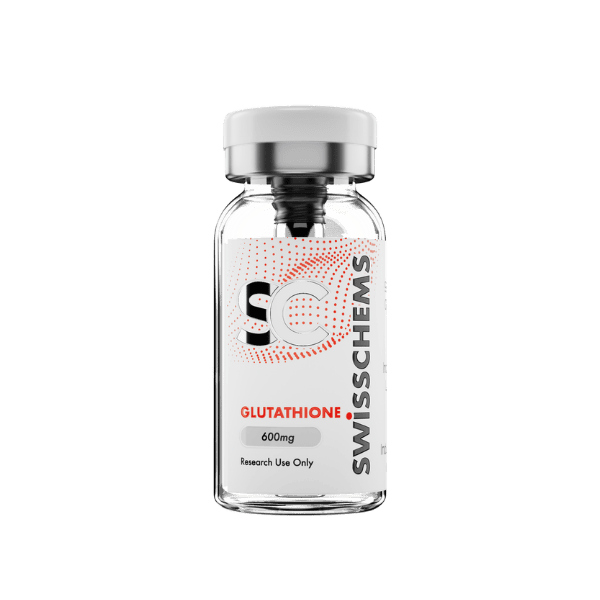
Glutathione, 600mg
During our packaging transition, you may receive products with either our previous or updated label. Rest assured, the formulation, purity and quality remain exactly the same as per our standards.

Glutathione (GSH) is a tripeptide thiol composed of glutamate, cysteine, and glycine, and is among the most extensively studied low-molecular-weight redox-active molecules in biological systems. Through its reactive sulfhydryl group, GSH participates in oxidation-reduction reactions, thiol-disulfide exchange processes, and cofactor-dependent enzymatic mechanisms. It serves as an obligate co-substrate for multiple enzyme families, including glutathione peroxidases (GPx), glutathione S-transferases (GST), and glutaredoxins, where it contributes to redox-regulated biochemical pathways and enzyme-mediated signaling processes.
Experimental investigations have extensively utilized GSH for studies of redox biology, thiol chemistry, enzyme-cofactor interactions, glutathione-dependent regulatory networks, and signal transduction mechanisms involving sulfur-containing biomolecules. Research applications include glutathione system characterization, GPx and GST pathway investigation, glutaredoxin-associated signaling studies, redox system analysis, and mechanistic evaluation of thiol-dependent biochemical processes.
- High Purity – 99% Purity Guaranteed
- Independently Lab Tested
- Research Grade Quality
- For Laboratory Research Use Only
3D Molecular Structure
Drag to rotate · scroll to zoom| Chemical Formula | C10H17N3O6S |
|---|---|
| Synonyms | 0-18-8, L-Glutathione, Glutathion, Isethion, L-gamma-glutamyl-L-cysteinylglycine |
| Molar Mass | 307.33 g/mol |
| CAS Number | 70-18-8 |
| PubChem CID | 124886 |
| Total Compound Content | 600 mg per vial |
| Shelf Life | 24 months |
Every batch is independently lab tested for identity, purity and potency. View our lab testing program →
What distinguishes glutathione from glutathione precursor compounds in biochemical research?
Glutathione (GSH) is the fully assembled tripeptide consisting of glutamate, cysteine, and glycine, whereas precursor compounds participate in upstream glutathione biosynthetic pathways. As the completed molecule, GSH serves directly as a substrate and cofactor for multiple glutathione-dependent enzyme systems, making it a valuable research tool for investigating redox chemistry, thiol-disulfide exchange processes, enzyme-cofactor interactions, and glutathione-associated regulatory mechanisms.
What is the relationship between glutathione and the Nrf2/ARE signaling pathway?
The Nrf2/ARE pathway is a well-characterized transcriptional regulatory system associated with glutathione-related biochemical processes. Experimental investigations have examined interactions between glutathione-dependent redox systems, Nrf2-associated signaling mechanisms, and the regulation of enzymes involved in glutathione biosynthesis and utilization. These relationships make glutathione a useful research tool for studies of redox-regulated signaling networks, transcriptional regulation, and thiol-dependent biochemical pathways.
How is glutathione commonly analyzed in laboratory research?
Glutathione is frequently characterized using analytical techniques including high-performance liquid chromatography (HPLC), liquid chromatography-mass spectrometry (LC-MS), fluorescence-based derivatization methods, and colorimetric thiol assays. These approaches enable investigation of GSH/GSSG redox systems, glutathione-associated enzyme activity, thiol chemistry, and redox-regulated biochemical processes. Such analytical methods have established glutathione as a widely utilized molecule in studies of redox biology, enzyme kinetics, and cofactor-dependent signaling mechanisms.
-
-
SALE
-
-
SALE

-
-
SALE
-
-