Product Usage: This product is intended for research purposes only.
All product information available on this website is for educational purposes only. Any form of bodily introduction into humans or animals is strictly prohibited by law. This product should only be handled by licensed and qualified professionals. It is not a drug, food, or cosmetic, and must not be misbranded, misused, or mislabeled as such.
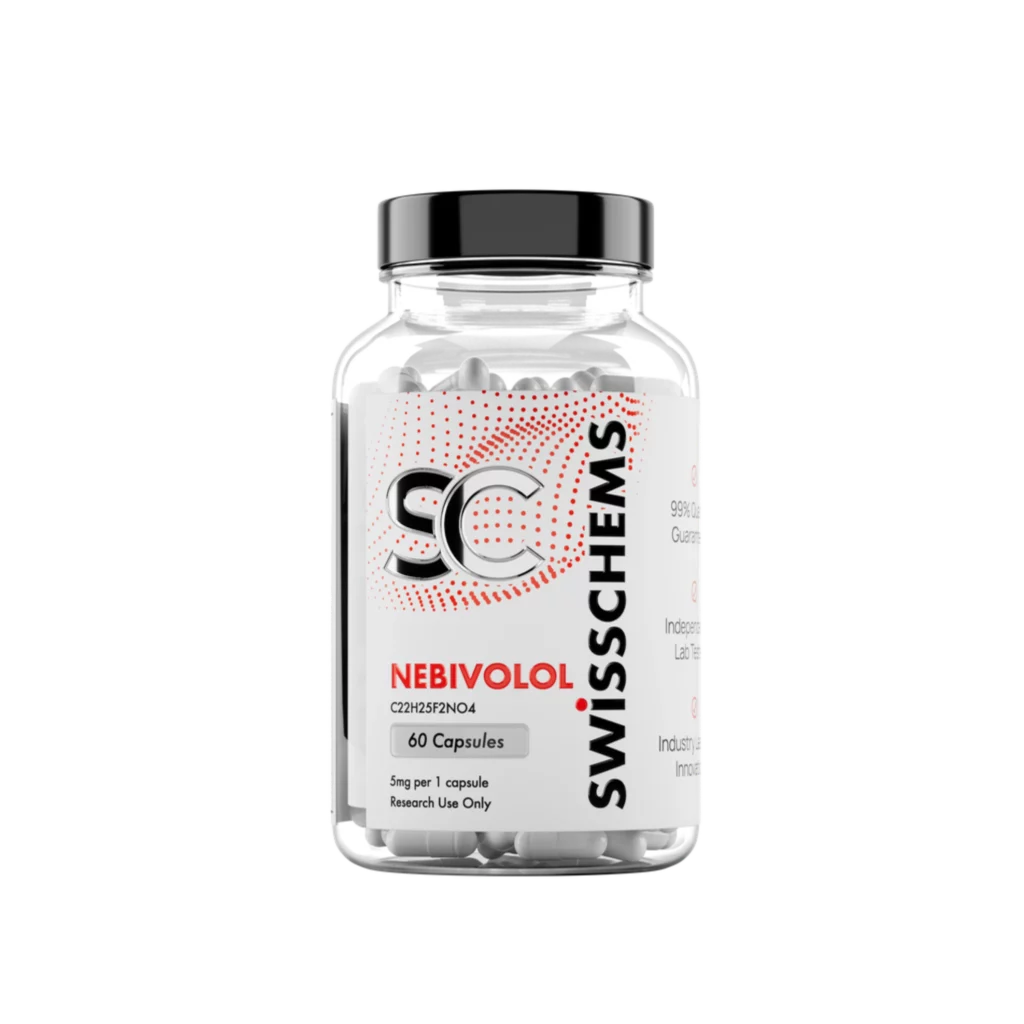
Nebivolol 300 mg (5 mg / 60 capsules)
During our packaging transition, you may receive products with either our previous or updated label. Rest assured, the formulation, purity and quality remain exactly the same as per our standards.

Nebivolol is a third-generation β-adrenoceptor blocker with high β1-selectivity and a unique secondary mechanism: activation of endothelial nitric oxide synthase (eNOS) via GRK/β-arrestin biased agonism, producing vasodilation absent from earlier-generation β-blockers. Research applications include β1-AR pharmacology, biased agonism at β-adrenoceptors, eNOS activation pathway investigation, and NO-mediated vascular biology research.
- High Purity – 99% Purity Guaranteed
- Independently Lab Tested
- Research Grade Quality
- For Laboratory Research Use Only
3D Molecular Structure
Drag to rotate · scroll to zoom| Chemical Formula | C22H25F2NO4 |
|---|---|
| Synonyms | Bystolic (trade name), Nebilet (trade name), Nebivololum |
| Molar Mass | 405.44 g/mol |
| CAS Number | 99200-09-06 |
| PubChem CID | 71301 |
| Total Compound Content | 300 mg (5 mg per capsule) |
| Shelf Life | 36 months |
Every batch is independently lab tested for identity, purity and potency. View our lab testing program →
What is the GRK/β-arrestin biased agonism mechanism that distinguishes nebivolol from other β-blockers?
Most β-blockers are Gα antagonists — they block Gsα-coupled cAMP signalling at β-ARs without activating alternative pathways. Nebivolol is also a GRK2/β-arrestin biased agonist at β2-AR: it activates GRK2-mediated receptor phosphorylation and β-arrestin recruitment without activating Gsα. β-arrestin then scaffolds EGFR transactivation and ERK1/2 phosphorylation cascades that activate eNOS and promote NO production. This G protein-independent, β-arrestin-dependent signalling produces vasodilation that is absent from pure Gα-antagonist β-blockers. This biased agonism mechanism is also documented for carvedilol and represents an active area of β-AR pharmacology research.
How does nebivolol's eNOS activation differ mechanistically from direct NO donors in vascular research?
Direct NO donors (nitroprusside, SNAP, DETA-NONOate) deliver exogenous NO or spontaneously release it, bypassing eNOS entirely. Nebivolol activates endogenous eNOS via β-arrestin/EGFR/Akt signalling, producing NO through the physiological L-arginine/NOS pathway in vascular endothelial cells. This eNOS-dependent NO production is subject to normal substrate availability, NOS regulation, and shear stress modulation — making nebivolol relevant to studies examining endogenous NO pathway activation versus exogenous NO supplementation. The eNOS pathway activation also produces BH4-dependent effects on NOS coupling that differ from uncoupled exogenous NO delivery.
How do CYP2D6 polymorphisms affect nebivolol pharmacokinetics in research studies?
Nebivolol is predominantly metabolised by CYP2D6 via hydroxylation and glucuronidation. CYP2D6 poor metabolisers (approximately 7–10% of Caucasian populations, 2% of Asians) have significantly higher nebivolol plasma exposure and longer effective half-life compared to extensive metabolisers. In pharmacogenomic research designs, CYP2D6 genotyping of experimental subjects is important for interpreting interindividual variation in nebivolol PK/PD relationships. This CYP2D6 dependence is shared by several β-blockers (metoprolol, carvedilol) but not others (atenolol, bisoprolol), making nebivolol useful in comparative CYP2D6-dependent versus independent β-blocker metabolism studies.
-
SALE
-
-