Product Usage: This product is intended for research purposes only.
All product information available on this website is for educational purposes only. Any form of bodily introduction into humans or animals is strictly prohibited by law. This product should only be handled by licensed and qualified professionals. It is not a drug, food, or cosmetic, and must not be misbranded, misused, or mislabeled as such.
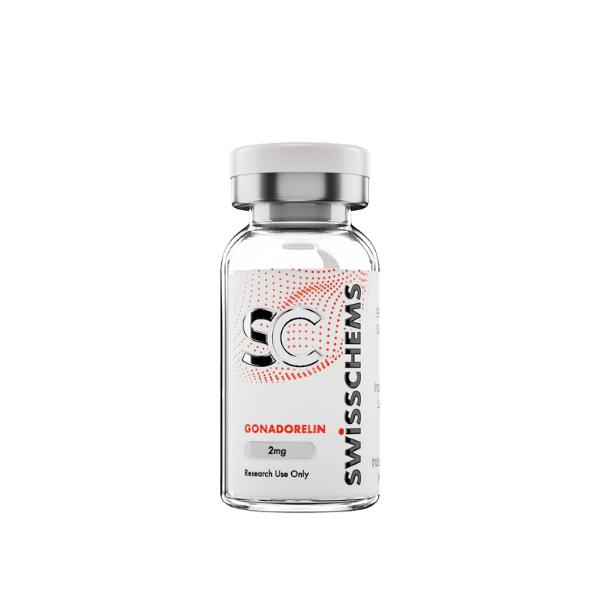
Gonadorelin 2mg
During our packaging transition, you may receive products with either our previous or updated label. Rest assured, the formulation, purity and quality remain exactly the same as per our standards.

Gonadorelin (synthetic GnRH/LHRH) is a synthetic decapeptide identical in sequence to the endogenous hypothalamic gonadotropin-releasing hormone. Pulsatile GnRH receptor (GnRHR) activation drives pulsatile LH and FSH release from pituitary gonadotrophs; continuous receptor activation produces GnRHR downregulation and gonadotropin suppression. Research applications include GnRHR pharmacology, HPG-axis pulsatility investigation, gonadotropin secretion dynamics, and pulse-versus-continuous agonism comparison studies.
- High Purity – 99% Purity Guaranteed
- Independently Lab Tested
- Research Grade Quality
- For Laboratory Research Use Only
3D Molecular Structure
Drag to rotate · scroll to zoom| Chemical Formula | C55H75N17O13 |
|---|---|
| Synonyms | Luliberin, Dirigestran, Fertagyl, Gonadorelina, Gonadorelinum, Gonadotropin-releasing hormone, LH-releasing factor |
| Molar Mass | 1,182.31 g/mol |
| CAS Number | 33515-09-02 |
| PubChem CID | 638793 |
| Total Compound Content | 2 mg per vial |
| Shelf Life | 36 months |
Every batch is independently lab tested for identity, purity and potency. View our lab testing program →
Why does pulsatile GnRH stimulate receptor signalling while continuous GnRH produces receptor desensitisation?
GnRHR is a Gq/11-coupled receptor whose signalling output is highly dependent on the pattern of ligand exposure. Intermittent receptor activation allows signalling pathways to reset between stimulation events, maintaining receptor availability and responsiveness. In contrast, continuous receptor occupancy promotes receptor phosphorylation, β-arrestin recruitment, internalisation, and desensitisation mechanisms that reduce subsequent signalling capacity. This pulse-frequency dependence is a defining characteristic of GnRHR biology and makes gonadorelin an important research tool for investigating receptor regulation, signal-transduction dynamics, and temporal control of GPCR signalling.
How does gonadorelin differ from long-acting GnRH analogues in research applications?
Gonadorelin is the native GnRH decapeptide and serves as the reference compound for studies of physiological GnRHR activation. Long-acting GnRH analogues incorporate structural modifications that increase receptor affinity, enzymatic stability, and duration of action. As a result, gonadorelin is typically used when investigating acute receptor activation, pulsatile signalling dynamics, and endogenous GnRH pathway biology, whereas longer-acting analogues are valuable tools for studying receptor desensitisation, sustained receptor occupancy, and long-duration GnRHR signalling mechanisms.
Why is gonadorelin considered the reference compound for GnRHR pharmacology?
Because gonadorelin is structurally identical to endogenous GnRH, it provides the benchmark against which synthetic GnRH analogues are compared. Its receptor-binding properties, signalling characteristics, and pharmacological profile have been extensively characterised, making it a standard tool for studies of GnRHR activation, receptor regulation, signalling kinetics, ligand-receptor interactions, and comparative GnRH analogue pharmacology.