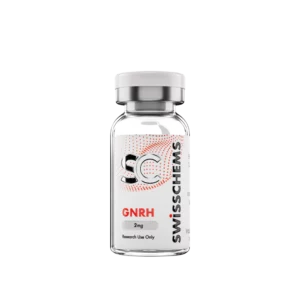
Product Usage: This product is intended for research purposes only.
All product information available on this website is for educational purposes only. Any form of bodily introduction into humans or animals is strictly prohibited by law. This product should only be handled by licensed and qualified professionals. It is not a drug, food, or cosmetic, and must not be misbranded, misused, or mislabeled as such.
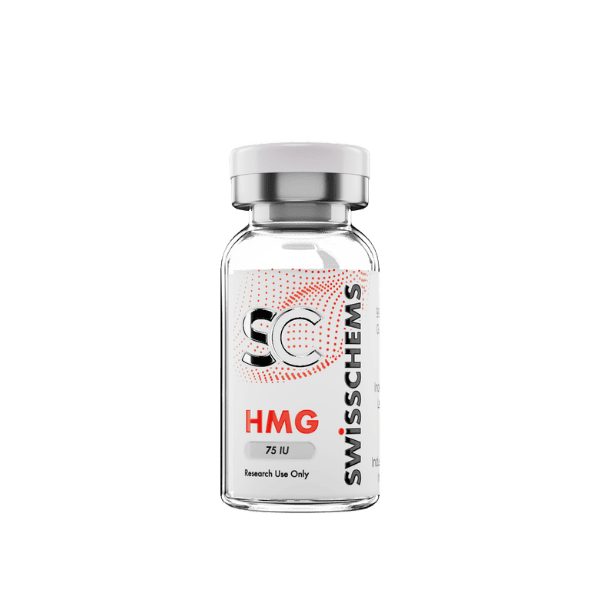
HMG 75 IU
During our packaging transition, you may receive products with either our previous or updated label. Rest assured, the formulation, purity and quality remain exactly the same as per our standards.

Human Menopausal Gonadotropin (HMG) is a gonadotropin preparation containing both follicle-stimulating hormone (FSH) and luteinizing hormone (LH) activity. These glycoprotein hormones interact with their respective receptors, follicle-stimulating hormone receptor (FSHR) and luteinizing hormone/choriogonadotropin receptor (LHCGR), both of which belong to the G protein-coupled receptor (GPCR) superfamily. Activation of these receptors initiates Gsα-coupled signaling pathways, resulting in intracellular cAMP generation, protein kinase A (PKA) activation, and downstream signal transduction processes.
Experimental investigations have utilized HMG as a research tool for studying gonadotropin receptor pharmacology, receptor-ligand interactions, GPCR signaling mechanisms, receptor activation kinetics, and comparative analyses of FSHR and LHCGR-mediated pathways. Research applications include gonadotropin signaling studies, receptor characterization, signal transduction investigations, and mechanistic evaluation of glycoprotein hormone receptor biology.
- High Purity – 99% Purity Guaranteed
- Independently Lab Tested
- Research Grade Quality
- For Laboratory Research Use Only
| Chemical Formula | N/A |
|---|---|
| Synonyms | 6,6-dimethylheptanal, Human Menopausal Gonadotrophin, Menotrophin, gonadotropin from human menopausal urine |
| Molar Mass | 142.24 g/mol |
| CAS Number | 61489-71-2 |
| PubChem CID | N/A |
| Total Compound Content | 75 IU per vial |
| Shelf Life | 36 months |
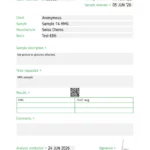
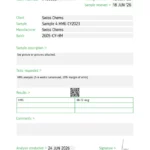
Why is there no purity percentage on the lab report for HMG?
HMG is a complex glycoprotein hormone, so it behaves differently from synthetic peptides like BPC-157 or Ipamorelin during HPLC testing. Its structure can produce multiple peaks, making a single purity percentage inaccurate.
Instead, its quality is assessed through identity and hormone content, which are more meaningful measures for this product.
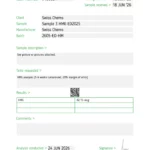
Why doesn't the figure on the HMG report match the IU on the label?
IU measures biological activity, while independent laboratory testing measures the amount of hormone by weight. Direct activity testing requires specialized bioassays that are not typically available through independent laboratories.
For HMG, the laboratory reports hormone content by weight because its FSH and LH components cannot be combined into a single IU value through standard testing.
In short, these lab reports measure hormone identity and content, not biological potency. Differences from the labeled IU do not necessarily indicate a problem with the batch.
What is the significance of combined FSH and LH activity in HMG research?
HMG contains both follicle-stimulating hormone (FSH) and luteinizing hormone (LH) bioactivity, enabling simultaneous investigation of follicle-stimulating hormone receptor (FSHR) and luteinizing hormone/choriogonadotropin receptor (LHCGR) signaling pathways. This combined receptor activity makes HMG a useful research tool for studying gonadotropin receptor pharmacology, receptor-ligand interactions, comparative GPCR signaling mechanisms, and the relationship between FSHR- and LHCGR-mediated signal transduction processes.
How does HMG differ from recombinant gonadotropin preparations?
HMG contains multiple glycoprotein hormone isoforms exhibiting varying degrees of glycosylation and sialylation, whereas recombinant preparations are generally characterized by more defined glycoform profiles. This molecular heterogeneity has made HMG valuable for investigations examining glycoprotein hormone structure-function relationships, receptor binding characteristics, glycoform-dependent signaling behavior, and the influence of glycosylation patterns on receptor activation kinetics.
What signaling pathways are activated by FSHR and LHCGR?
FSHR and LHCGR are members of the G protein-coupled receptor (GPCR) superfamily that primarily signal through Gsα-mediated activation of adenylyl cyclase, resulting in intracellular cAMP generation and protein kinase A (PKA) activation. These receptors are widely utilized in research examining GPCR signaling dynamics, receptor activation mechanisms, second-messenger systems, receptor-ligand interactions, and downstream signal transduction pathways associated with glycoprotein hormone receptor biology.
-
-
-
-
SALE