Product Usage: This product is intended for research purposes only.
All product information available on this website is for educational purposes only. Any form of bodily introduction into humans or animals is strictly prohibited by law. This product should only be handled by licensed and qualified professionals. It is not a drug, food, or cosmetic, and must not be misbranded, misused, or mislabeled as such.
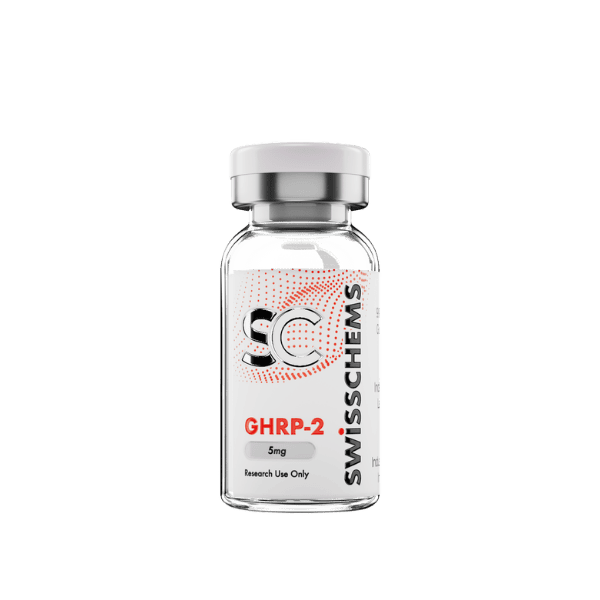
GHRP-2 5mg
During our packaging transition, you may receive products with either our previous or updated label. Rest assured, the formulation, purity and quality remain exactly the same as per our standards.

GHRP-2 (Pralmorelin) is a synthetic hexapeptide compound studied for selective ghrelin receptor binding properties and growth hormone secretagogue signalling in experimental models. The compound consists of six amino acids (D-Ala-D-β-Nal-Ala-Trp-D-Phe-Lys-NH2) and is examined for its capacity to engage the GHS-R1a (growth hormone secretagogue receptor 1a) in pituitary and hypothalamic research models. Research applications include ghrelin receptor pharmacology, growth hormone secretagogue pathway studies, and pulsatile GH signalling research.
- High Purity – 99% Purity Guaranteed
- Independently Lab Tested
- Research Grade Quality
- For Laboratory Research Use Only
3D Molecular Structure
Drag to rotate · scroll to zoom| Chemical Formula | C45H55N9O6 |
|---|---|
| Synonyms | Pralmorelin, KP-102, D-Alanyl-3-(2-naphthalenyl)-D-alanyl-L-alanyl-L-tryptophyl-D-phenylalanyl-L-lysinamide, UNII-E6S6E1F19M |
| Molar Mass | 817.9865 g/mol |
| CAS Number | 158861-67-7 |
| PubChem CID | 6918245 |
| Total Compound Content | 5mg per vial |
| Shelf Life | 36 months |
Every batch is independently lab tested for identity, purity and potency. View our lab testing program →
What receptor does GHRP-2 bind to and how is this studied in laboratory models?
GHRP-2 is studied for selective agonist activity at the GHS-R1a (growth hormone secretagogue receptor 1a), which is expressed in pituitary somatotroph cells and hypothalamic nuclei. Cell-based binding assays using GHS-R1a-expressing cell lines, alongside downstream signalling readouts (such as cAMP accumulation and calcium mobilization), are standard methods for characterising GHRP-2's receptor engagement and functional potency relative to other GHS-R1a ligands.
What distinguishes GHRP-2's proposed mechanism from GHRH-based research tools?
GHRP-2 engages the ghrelin/GHS-R1a receptor pathway, distinct from the GHRH receptor pathway targeted by GHRH analogues such as CJC-1295. Research protocols frequently pair GHRP-2 with GHRH analogues to examine whether GHS-R1a agonism and GHRH receptor activation produce synergistic effects on growth hormone secretagogue signalling endpoints, a common combination design in pituitary pathway research.
What experimental controls are commonly used in GHRP-2 receptor-signalling research?
Studies investigating GHRP-2 mechanisms typically incorporate vehicle controls, receptor-antagonist controls, and comparator GHS-R1a agonists to distinguish receptor-specific effects from non-specific pathway activation. Comparative experiments using compounds such as GHRP-6 or Ipamorelin are commonly employed to evaluate differences in signalling selectivity, pathway activation patterns, receptor responsiveness, and downstream transcriptional responses. These approaches help establish mechanistic attribution in GHS-R1a pharmacology research.
-
-
-
SALE
-