Product Usage: This product is intended for research purposes only.
All product information available on this website is for educational purposes only. Any form of bodily introduction into humans or animals is strictly prohibited by law. This product should only be handled by licensed and qualified professionals. It is not a drug, food, or cosmetic, and must not be misbranded, misused, or mislabeled as such.
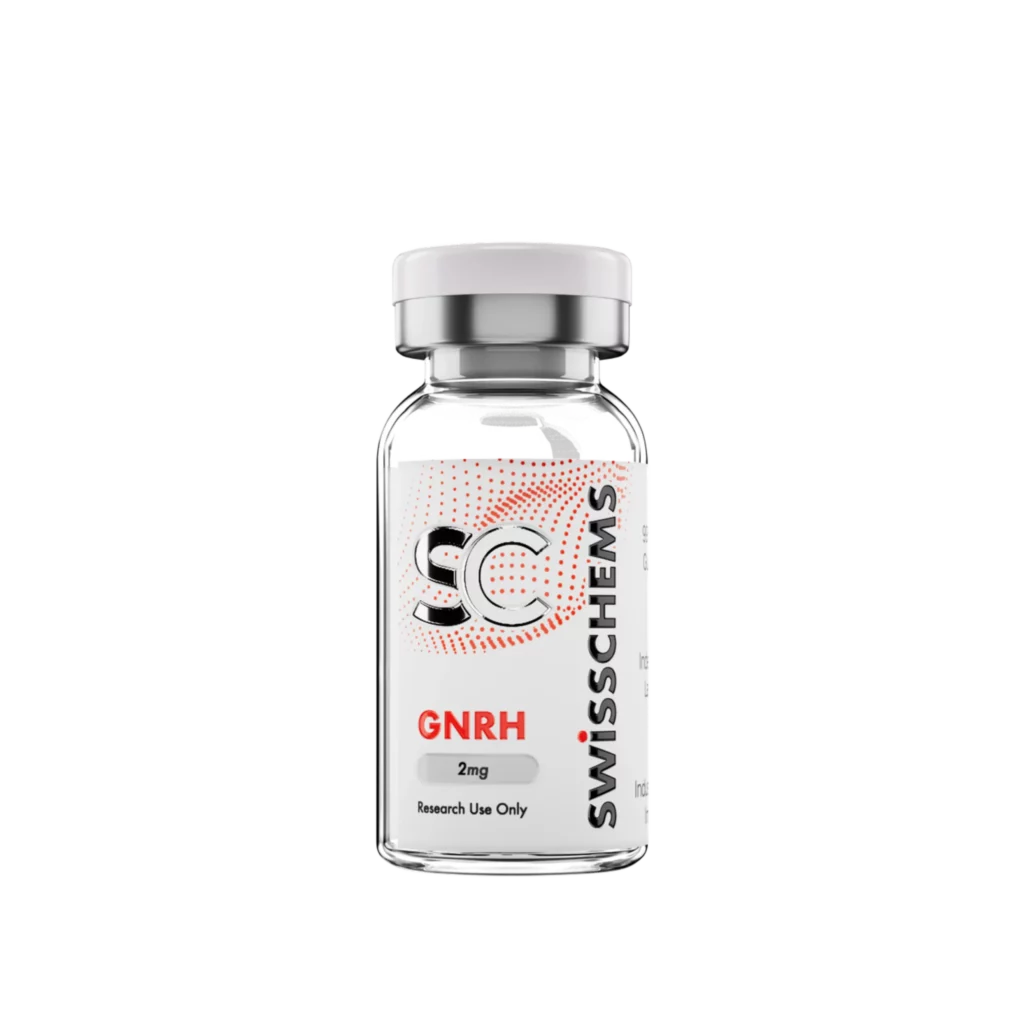
GnRH (Triptorelin) 2mg
During our packaging transition, you may receive products with either our previous or updated label. Rest assured, the formulation, purity and quality remain exactly the same as per our standards.

Triptorelin (D-Trp6-LHRH) is a decapeptide GnRH analogue with a single D-tryptophan substitution at position 6 that confers greater GnRHR binding affinity and substantially extended plasma half-life relative to gonadorelin. Unlike native GnRH (which requires pulsatile delivery to sustain gonadotropin secretion), triptorelin's extended half-life produces continuous GnRHR engagement — driving initial gonadotropin surge followed by receptor downregulation and sustained HPG-axis suppression. Research applications include GnRHR pharmacology, HPG-axis suppression modelling, chemical castration models, and GnRH analogue comparative pharmacology.
- High Purity – 99% Purity Guaranteed
- Independently Lab Tested
- Research Grade Quality
- For Laboratory Research Use Only
3D Molecular Structure
Drag to rotate · scroll to zoom| Chemical Formula | C64H82N18O13 |
|---|---|
| Synonyms | Triptorelin, GnRH agonist, Decapeptyl, D-Trp6-LHRH |
| Molar Mass | 1,311.47 g/mol |
| CAS Number | 57773-63-4 |
| PubChem CID | 25074470 |
| Total Compound Content | 2 mg per vial |
| Shelf Life | 36 months |
Every batch is independently lab tested for identity, purity and potency. View our lab testing program →
Why does triptorelin produce HPG-axis suppression despite being a GnRH receptor agonist?
Triptorelin produces sustained GnRH receptor (GnRHR) activation rather than the physiological pulsatile stimulation required for normal gonadotroph signalling. Continuous receptor occupancy leads to receptor internalisation, reduced surface GnRHR expression, and progressive desensitisation of downstream signalling pathways. As receptor responsiveness declines, LH and FSH secretion decreases, making triptorelin a valuable research tool for studying GnRHR regulation, receptor desensitisation, and HPG-axis suppression mechanisms.
How does triptorelin differ from gonadorelin in research applications?
Gonadorelin is the native GnRH peptide and is primarily used to investigate acute GnRHR activation, pituitary responsiveness, and pulsatile signalling physiology. Triptorelin is a long-acting GnRH analogue with enhanced receptor affinity and prolonged activity, making it suitable for studies of sustained receptor activation, receptor downregulation, gonadotroph desensitisation, and long-term HPG-axis regulation. Although both act at GnRHR, they are used to investigate fundamentally different signalling states.
What endpoints are commonly measured in triptorelin studies?
Common endpoints include GnRHR expression, receptor internalisation, gonadotroph signalling activity, LH and FSH secretion, downstream transcriptional responses, receptor recovery kinetics, and biomarkers of HPG-axis regulation. These measurements help characterize the transition from acute receptor activation to long-term receptor desensitisation and suppression.
-
SALE
-
SALE
-
SALE

-
SALE

-
-