Product Usage: This product is intended for research purposes only.
All product information available on this website is for educational purposes only. Any form of bodily introduction into humans or animals is strictly prohibited by law. This product should only be handled by licensed and qualified professionals. It is not a drug, food, or cosmetic, and must not be misbranded, misused, or mislabeled as such.
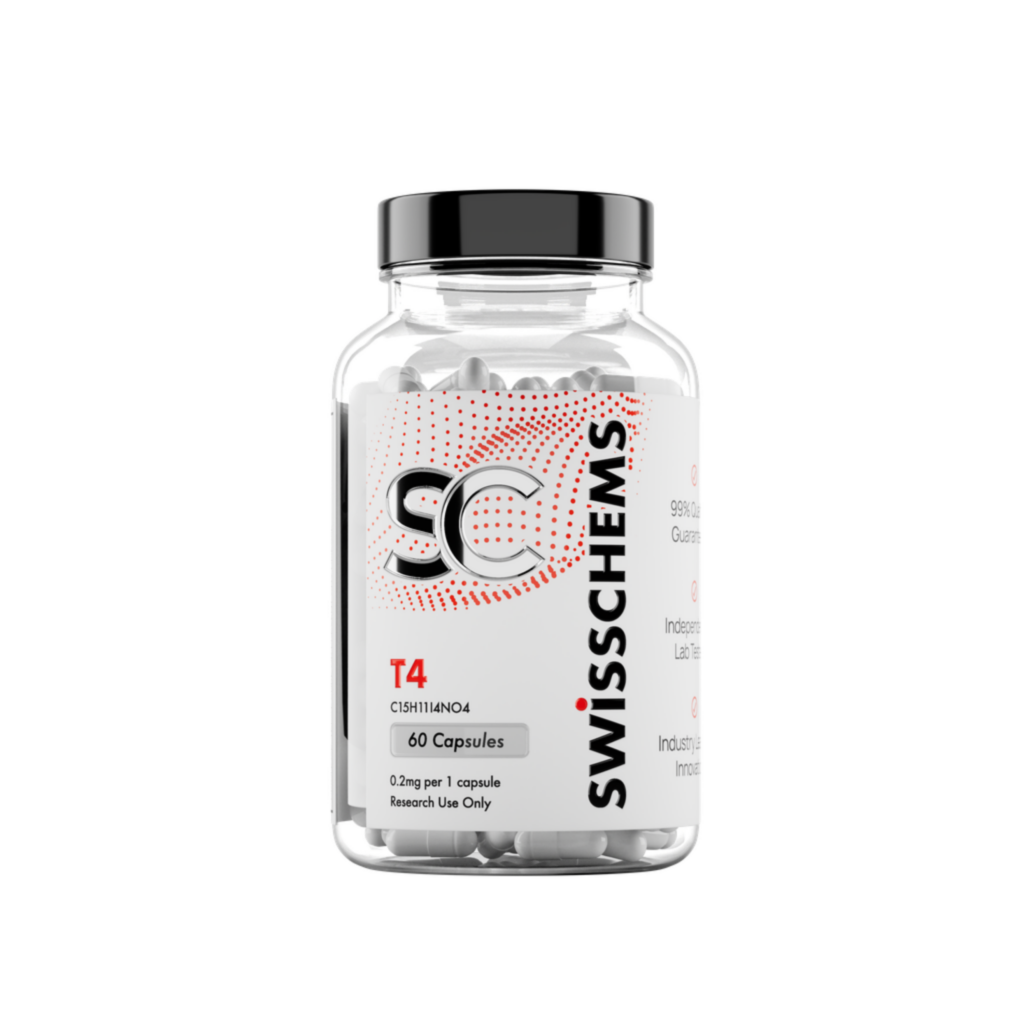
Levothyroxine T4 (0.2mg/60caps)
During our packaging transition, you may receive products with either our previous or updated label. Rest assured, the formulation, purity and quality remain exactly the same as per our standards.

Levothyroxine (L-thyroxine, T4) is an iodinated amino acid derivative utilized as a reference compound in studies of thyroid hormone biochemistry, metabolism, and signaling. It serves as a substrate for deiodinase enzymes (DIO1, DIO2, and DIO3), which catalyze selective deiodination reactions and regulate downstream thyroid hormone-associated molecular pathways. Experimental investigations have employed T4 in studies of deiodinase enzymology, thyroid hormone transport proteins, nuclear receptor signaling, transcriptional regulation, metabolic pathway modulation, and endocrine signaling networks. Its well-characterized biochemical properties make it a valuable research tool for investigations of thyroid hormone metabolism, deiodinase-dependent conversion mechanisms, receptor-mediated signaling pathways, and comparative analyses of thyroid hormone-associated molecular processes. Supplied in capsule format.
- High Purity – 99% Purity Guaranteed
- Independently Lab Tested
- Research Grade Quality
- For Laboratory Research Use Only
3D Molecular Structure
Drag to rotate · scroll to zoom| Chemical Formula | C15H11I4NO4 |
|---|---|
| Synonyms | Thyroxine, L-Thyroxine, T4, Synthroid (trade name), Levothroid (trade name) |
| Molar Mass | 776.87 g/mol |
| CAS Number | 51-48-9 |
| PubChem CID | 5819 |
| Total Compound Content | 12 mg (0.2 mg per capsule) |
| Shelf Life | 36 months |
Every batch is independently lab tested for identity, purity and potency. View our lab testing program →
Why is T4 considered a precursor molecule rather than the primary active iodothyronine?
T4 exhibits lower affinity for thyroid hormone receptors than T3 and functions primarily as a substrate for deiodinase-mediated conversion pathways. Its biological significance is largely derived from enzymatic deiodination by DIO1 and DIO2, which generate T3 and thereby regulate downstream receptor-associated signaling. This relationship makes T4 a valuable research tool for investigating deiodinase-dependent activation mechanisms, iodothyronine metabolism, and the regulation of receptor-accessible signaling molecules.
How do DIO1 and DIO2 differ in iodothyronine metabolism studies?
DIO1 and DIO2 both catalyze outer-ring deiodination of T4 to T3 but differ in their kinetic properties, substrate handling characteristics, and regulatory roles within iodothyronine metabolism. DIO1 is commonly investigated in studies of bulk iodothyronine turnover and circulating metabolite generation, whereas DIO2 is frequently examined as a regulator of localized intracellular T3 production. Comparative analysis of these enzymes is central to understanding deiodinase-dependent control of iodothyronine signaling pathways and metabolic regulation.
What distinguishes T4 from T3 in deiodinase and receptor-signaling research?
T4 is primarily utilized as a substrate for deiodinase-mediated conversion studies, allowing investigation of enzymatic activation pathways and regulation of iodothyronine metabolism. T3, by contrast, directly engages thyroid hormone receptors without requiring prior deiodination. As a result, T4 is commonly employed in studies examining deiodinase activity, substrate conversion kinetics, and iodothyronine metabolic pathways, while T3 is used in experiments focused on direct receptor activation and downstream transcriptional signaling mechanisms.
-
-
-
-
-
SALE
-
SALE