Product Usage: This product is intended for research purposes only.
All product information available on this website is for educational purposes only. Any form of bodily introduction into humans or animals is strictly prohibited by law. This product should only be handled by licensed and qualified professionals. It is not a drug, food, or cosmetic, and must not be misbranded, misused, or mislabeled as such.
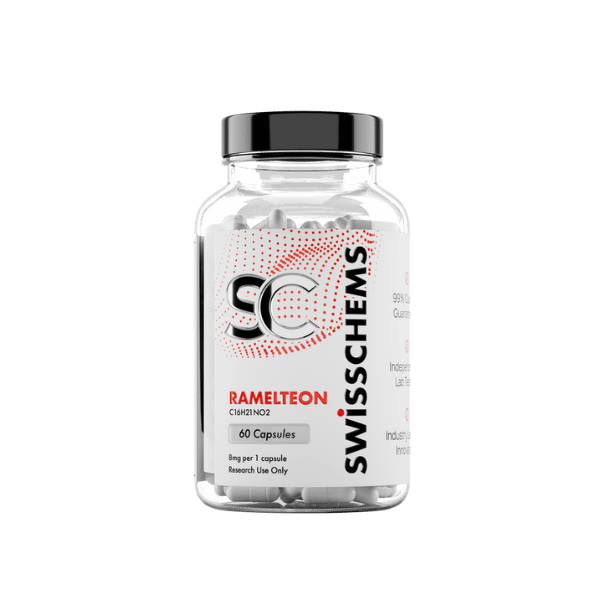
Ramelteon (8mg/capsule), 60 Capsules
During our packaging transition, you may receive products with either our previous or updated label. Rest assured, the formulation, purity and quality remain exactly the same as per our standards.

Ramelteon is a synthetic melatonin analogue studied for selective agonist activity at melatonin receptor subtypes MT1 and MT2 in experimental models. The compound's indanyl-furan scaffold structure confers high binding affinity at MT1 and MT2 receptors in the suprachiasmatic nucleus (SCN), with research interest in its proposed role in circadian rhythm entrainment and sleep-wake cycle regulation pathway research. Ramelteon is distinguished from other sleep-pathway research compounds by the absence of activity at GABA receptors, making it a selective research tool for isolating melatonergic pathway contributions in circadian signalling studies. Research applications include MT1/MT2 receptor pharmacology, circadian rhythm pathway studies, and comparative melatonin analogue receptor binding research.
- High Purity – 99% Purity Guaranteed
- Independently Lab Tested
- Research Grade Quality
- For Laboratory Research Use Only
3D Molecular Structure
Drag to rotate · scroll to zoom| Chemical Formula | C16H21NO2 |
|---|---|
| Synonyms | TAK-375, Rozerem, (S)-N-[2-(2,6,7,8-Tetrahydro-1H-indeno[5,4-b]furan-8-yl)ethyl]propionamide |
| Molar Mass | 259.34 g/mol |
| CAS Number | 196597-26-9 |
| Pubchem CID | 208902 |
| Total Compound Content | 480mg (8mg per capsule) |
| Shelf Life | 36 months |
Every batch is independently lab tested for identity, purity and potency. View our lab testing program →
What distinguishes Ramelteon's receptor selectivity profile from other melatonin receptor ligands?
Ramelteon demonstrates high binding affinity at MT1 and MT2 receptor subtypes with substantially lower affinity at MT3, and no measurable binding at a broad panel of other receptor binding sites including benzodiazepine, dopamine, opiate, and ion channel targets. This selectivity profile makes Ramelteon a standard tool compound in research examining specifically melatonergic receptor contributions to circadian rhythm and sleep-wake cycle pathway signalling, without the confounding receptor activities associated with non-selective melatonin ligands.
How is Ramelteon's proposed effect on circadian rhythm entrainment studied in experimental models?
Rodent circadian models measuring wheel-running activity rhythms and SCN neuronal firing patterns are standard experimental systems for studying Ramelteon's proposed phase-shifting and entrainment properties, typically examining the magnitude and direction of circadian phase shifts induced by compound administration at different circadian time points relative to vehicle controls. Ex vivo SCN electrophysiology preparations complement these in vivo approaches by allowing direct measurement of neuronal firing rate modulation following compound exposure.
How does Ramelteon's structural scaffold differ from native melatonin and what does this mean for receptor binding research?
Ramelteon's indanyl-furan scaffold is structurally distinct from native melatonin's indole-based structure, a difference studied in comparative structure-activity relationship research examining how the two structural frameworks interact with MT1/MT2 receptor binding sites. Ramelteon's scaffold confers significantly higher binding affinity at MT1 and MT2 relative to native melatonin, making it a useful reference compound for distinguishing high-affinity versus low-affinity melatonin receptor binding contributions in circadian research models.