Product Usage: This product is intended for research purposes only.
All product information available on this website is for educational purposes only. Any form of bodily introduction into humans or animals is strictly prohibited by law. This product should only be handled by licensed and qualified professionals. It is not a drug, food, or cosmetic, and must not be misbranded, misused, or mislabeled as such.
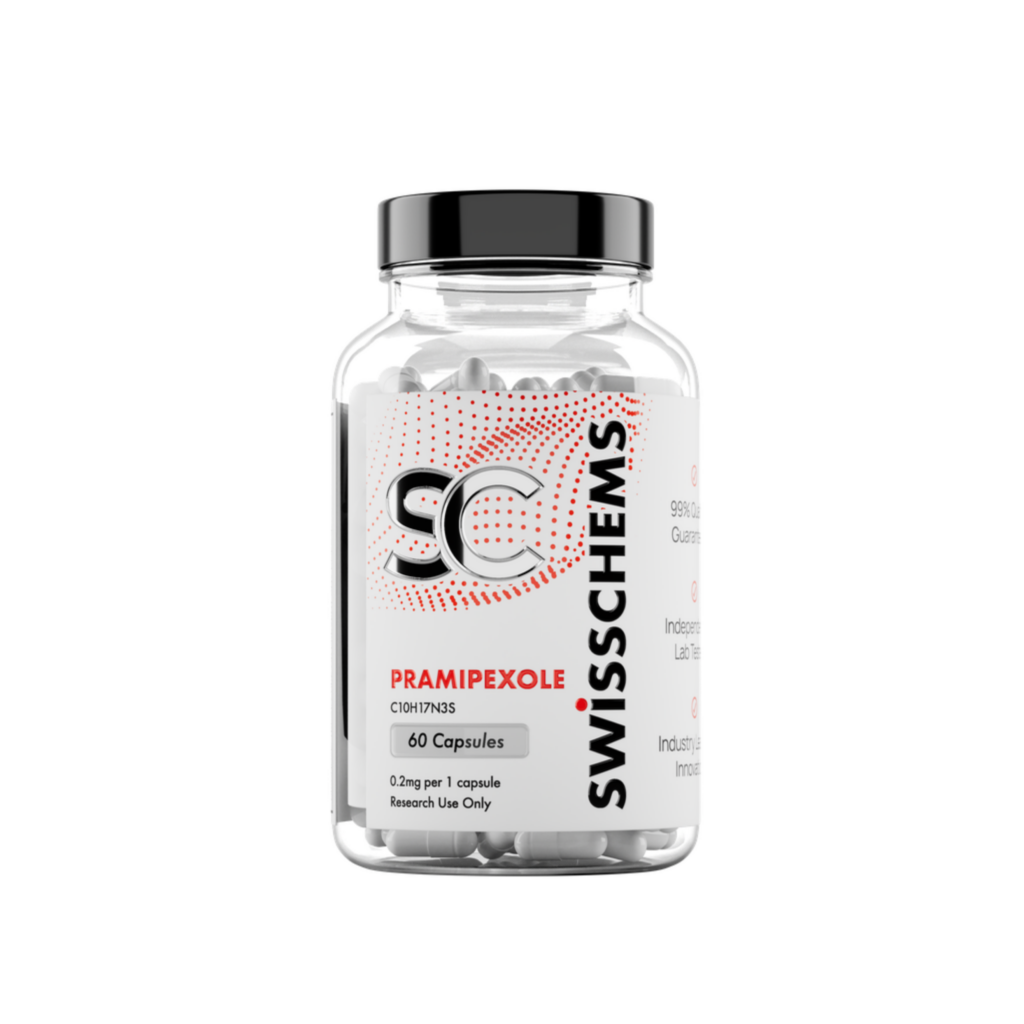
Pramipexole (Prami), 12 mg (0.2 mg/60 capsules)
During our packaging transition, you may receive products with either our previous or updated label. Rest assured, the formulation, purity and quality remain exactly the same as per our standards.

Pramipexole is a non-ergoline dopamine receptor agonist with preferential affinity for D3 receptors and additional activity at D2 receptor subtypes within the D2-like receptor family. Experimental investigations have examined its interactions with dopamine receptor-mediated signaling pathways, G protein-coupled receptor activation mechanisms, intracellular cAMP regulation, and receptor-ligand dynamics. Its receptor selectivity profile makes it a valuable research tool for studies of D2/D3 receptor pharmacology, dopaminergic signaling networks, receptor subtype selectivity, signal transduction mechanisms, and comparative investigations of dopamine receptor-mediated regulatory pathways.
- High Purity – 99% Purity Guaranteed
- Independently Lab Tested
- Research Grade Quality
- For Laboratory Research Use Only
3D Molecular Structure
Drag to rotate · scroll to zoom| Chemical Formula | C10H17N3S |
|---|---|
| Synonyms | Mirapex (trade name), Sifrol (trade name), PPX, (S)-Pramipexole |
| Molar Mass | 211.33 g/mol |
| CAS Number | 104632-26-0 |
| PubChem CID | 119570 |
| Total Compound Content | 12 mg (0.2 mg per capsule) |
| Shelf Life | 36 months |
Every batch is independently lab tested for identity, purity and potency. View our lab testing program →
What is pramipexole's receptor selectivity profile and why is D3 selectivity research-relevant?
Pramipexole exhibits preferential affinity for D3 receptors within the D2-like dopamine receptor family, with additional activity at D2 and D4 receptor subtypes. This receptor selectivity profile makes it a valuable research tool for investigating D3 receptor pharmacology, receptor subtype differentiation, dopaminergic signaling mechanisms, and comparative studies of D2-like receptor function. Experimental investigations frequently utilize pramipexole to examine receptor-ligand interactions, signal transduction pathways, and subtype-specific dopamine receptor regulation.
How is pramipexole used in dopaminergic signaling research?
Pramipexole is widely used as a selective dopaminergic probe for studies of D2-like receptor activation, G protein-coupled receptor signaling, intracellular cAMP regulation, and dopamine receptor-mediated communication networks. Its well-characterized receptor profile allows researchers to investigate the molecular and signaling consequences of D3-preferring receptor activation and compare these effects with broader dopaminergic signaling mechanisms.
What makes pramipexole useful for dopamine receptor pharmacology studies?
Pramipexole's high affinity for D3 receptors and established activity at D2-like receptor subtypes make it a valuable reference compound for investigations of receptor selectivity, dopamine receptor signaling pathways, ligand-receptor dynamics, and GPCR-mediated regulatory mechanisms. These characteristics support its use in mechanistic studies of dopaminergic pharmacology and comparative analyses of D2-family receptor function.
-
SALE
-
-
-
SALE