Product Usage: This product is intended for research purposes only.
All product information available on this website is for educational purposes only. Any form of bodily introduction into humans or animals is strictly prohibited by law. This product should only be handled by licensed and qualified professionals. It is not a drug, food, or cosmetic, and must not be misbranded, misused, or mislabeled as such.
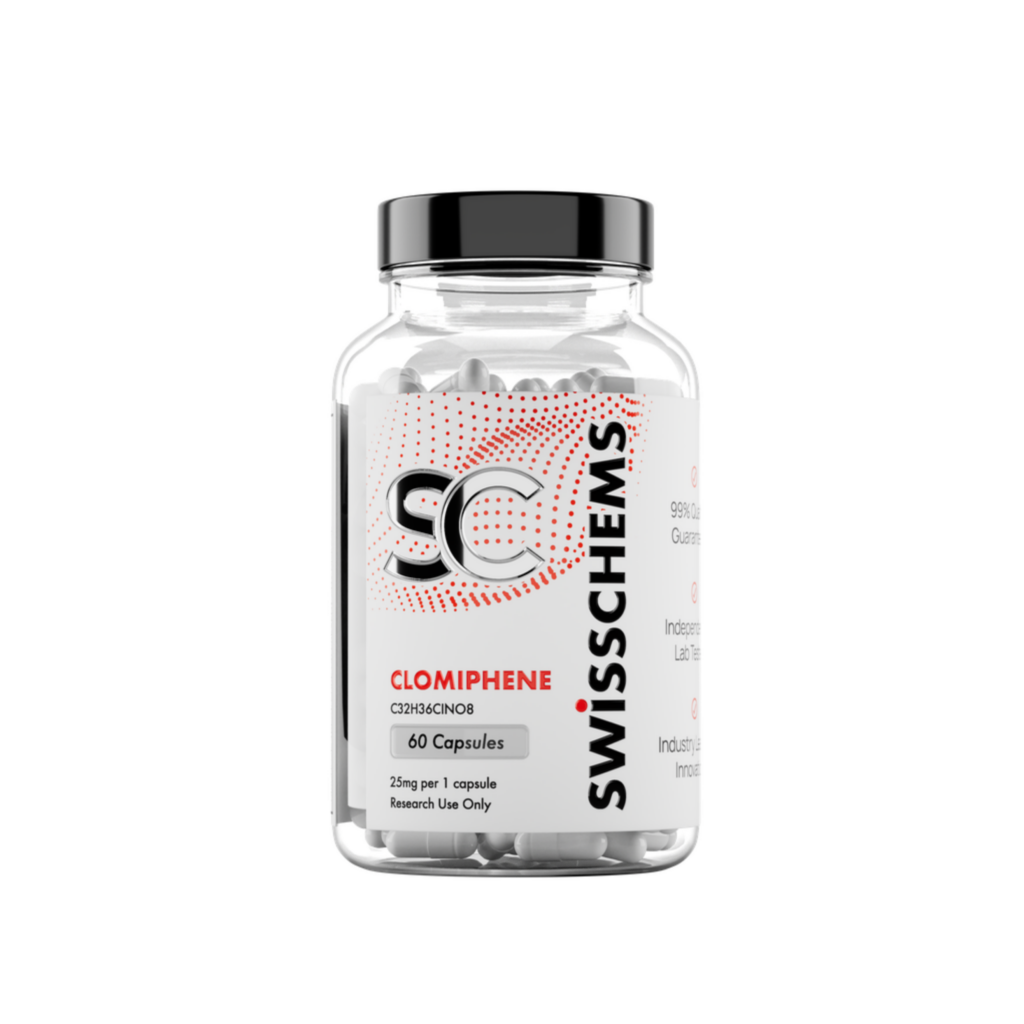
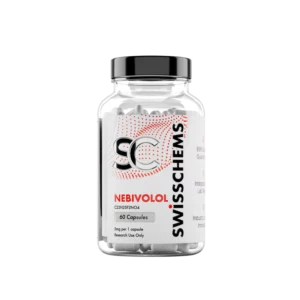
Clomiphene, 1500mg (25mg/capsule)
During our packaging transition, you may receive products with either our previous or updated label. Rest assured, the formulation, purity and quality remain exactly the same as per our standards.

Clomiphene is a racemic mixture of two geometric isomers of a triphenylethylene selective oestrogen receptor modulator (SERM): enclomiphene (trans-isomer, predominant ER antagonist) and zuclomiphene (cis-isomer, mixed ER agonist/antagonist). The racemic mixture has a well-characterised clinical pharmacological profile as a SERM used to investigate hypothalamic–pituitary–gonadal axis feedback. Research applications include SERM pharmacology, HPG-axis feedback investigation, and isomeric mixture vs. isolated isomer comparative studies.
- High Purity – 99% Purity Guaranteed
- Independently Lab Tested
- Research Grade Quality
- For Laboratory Research Use Only
3D Molecular Structure
Drag to rotate · scroll to zoom| Chemical Formula | C32H36ClNO8 |
|---|---|
| Synonyms | Clomiphene citrate salt, 2-(4-[2-Chloro-1,2-diphenylethenyl]phenoxy)-N,N-diethylethanamine, Clostilbegit, Dyneric, Klostilbegit, Serophene |
| Molar Mass | 598.1 g/mol |
| CAS Number | 50-41-9 |
| PubChem CID | 60974 |
| Total Compound Content | 1,500 mg (25 mg per capsule) |
| Shelf Life | 36 months |
Every batch is independently lab tested for identity, purity and potency. View our lab testing program →
What is the isomeric composition of clomiphene and how does it differ from enclomiphene?
Clomiphene is a racemic mixture of approximately 38% enclomiphene (trans-isomer) and 62% zuclomiphene (cis-isomer). Enclomiphene is predominantly an ER antagonist with a ~10-hour half-life. Zuclomiphene is a mixed ER agonist/antagonist with a ~30-day half-life, leading to accumulation with repeated dosing. SwissChems also supplies isolated enclomiphene (ENCLOMFNE-60) for studies requiring pure trans-isomer pharmacology without the zuclomiphene background.
Why does zuclomiphene's long half-life complicate mechanistic research with clomiphene?
Zuclomiphene accumulates with repeated dosing (t½ ~30 days vs. enclomiphene's ~10 hours), creating a progressively increasing background of ER agonist/antagonist activity that is difficult to control or quantify in repeat-dose study designs. This accumulation confounds attribution of pharmacodynamic effects to the enclomiphene component — the presumed primary active isomer for HPG-axis modulation. Researchers studying acute or isomer-specific ER antagonism at the HPG axis typically prefer isolated enclomiphene to avoid this confound.
What is clomiphene's mechanism of action at the hypothalamic-pituitary axis?
Clomiphene's primary HPG-axis mechanism is ER antagonism at hypothalamic arcuate nucleus KNDy neurons and pituitary gonadotrophs. Oestrogen-mediated negative feedback normally suppresses GnRH pulsatility and gonadotropin secretion. ER antagonism by clomiphene's enclomiphene component reduces this negative feedback, increasing GnRH pulse frequency and downstream LH/FSH secretion. The zuclomiphene component provides a counteracting partial ER agonist background that partially offsets this effect, resulting in the net gonadotropin-stimulating profile of the racemic mixture.
-
SALE
-
-
-
SALE
-
-
-
SALE