Product Usage: This product is intended for research purposes only.
All product information available on this website is for educational purposes only. Any form of bodily introduction into humans or animals is strictly prohibited by law. This product should only be handled by licensed and qualified professionals. It is not a drug, food, or cosmetic, and must not be misbranded, misused, or mislabeled as such.
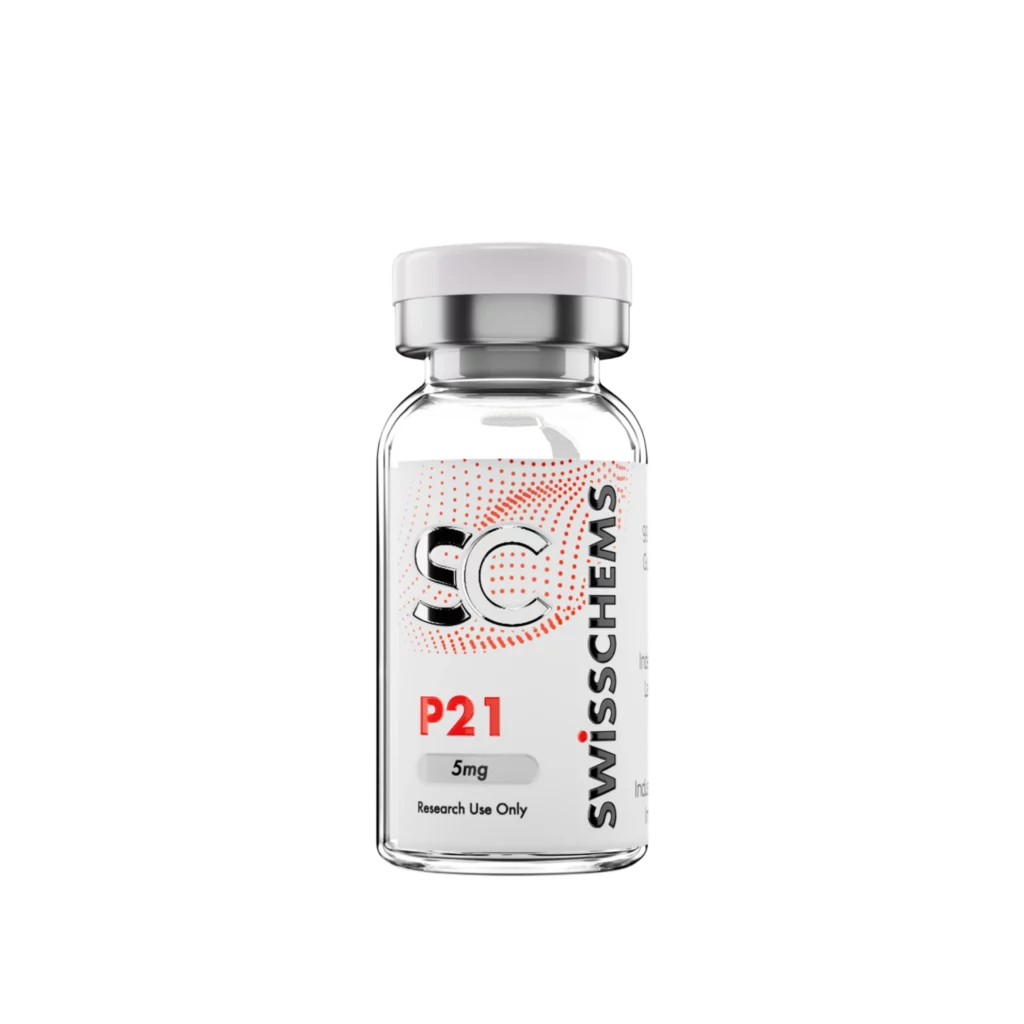
P21 5mg
NOTE: In some cases wherein the assigned top colors are out of stock, a different top color will be used to ensure that your order will not be delayed.
Peptides are stable at room temperature and can be stored in their original packaging for several days to weeks. For longer storage, keep them at 4 °C or colder, away from intense light. Do not shake peptides before or after reconstitution, refrigerate them, and handle with care.
You can purchase BAC water here:
BAC 10ml
During our packaging transition, you may receive products with either our previous or updated label. Rest assured, the formulation, purity and quality remain exactly the same as per our standards.

P21 (Peptide 021) is a synthetic tetrapeptide derived from a fragment of ciliary neurotrophic factor (CNTF), developed for experimental studies on neurotrophic signalling. Research interest centers on its proposed role in supporting neurogenesis and synaptic function research models, with structural modifications studied for their effect on compound stability and blood-brain barrier permeability characteristics. Research applications include CNTF pathway studies, neurotrophic peptide structure-activity research, and synaptic function investigation.
- High Purity – 99% Purity Guaranteed
- Independently Lab Tested
- Research Grade Quality
- For Laboratory Research Use Only
3D Molecular Structure
Drag to rotate · scroll to zoom| Chemical Formula | C27H42N6O8 |
|---|---|
| Synonyms | P021, Ac-dggl-adamatanylglycine-NH2, P-21 nootropic peptide |
| Molar Mass | 578.7 g/mol |
| CAS Number | 1246751-68-7 |
| PubChem CID | 56599151 |
| Total Compound Content | 5mg per vial |
| Shelf Life | 36 months |
Every batch is independently lab tested for identity, purity and potency. View our lab testing program →
What is the relationship between P21 and the parent CNTF protein in neurotrophic signalling research?
P21 is a synthetic peptide derived from a fragment of ciliary neurotrophic factor (CNTF), a signalling protein involved in neuronal growth, differentiation, and survival pathways. Research with P21 focuses on determining whether this smaller peptide fragment can reproduce selected downstream signalling effects associated with CNTF while providing a simplified tool for studying neurotrophic pathway regulation.
What structural modifications were incorporated into P21's design?
P21 incorporates modifications to the native CNTF-derived fragment that have been investigated for their effects on peptide stability and tissue distribution. Comparative structure-activity studies examine how these modifications influence degradation resistance, signalling activity, and overall experimental utility relative to unmodified peptide fragments.
What experimental endpoints are used to study P21's proposed effects on neurogenesis and synaptic function?
Research commonly utilizes neural cell culture systems to evaluate neurogenesis-associated biomarkers, neuronal differentiation markers, synaptic protein expression, and signalling pathways related to neuronal plasticity. Additional endpoints may include measurements of neurite outgrowth, cellular maturation, and electrophysiological markers of synaptic activity to characterize effects on neural network function.
-
-
-
-
SALE
-
SALE
-