Product Usage: This product is intended for research purposes only.
All product information available on this website is for educational purposes only. Any form of bodily introduction into humans or animals is strictly prohibited by law. This product should only be handled by licensed and qualified professionals. It is not a drug, food, or cosmetic, and must not be misbranded, misused, or mislabeled as such.
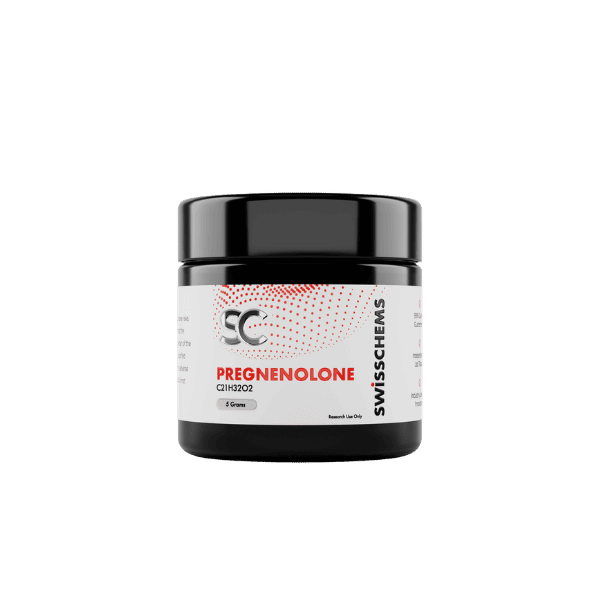
Pregnenolone – Powder, 5 grams
During our packaging transition, you may receive products with either our previous or updated label. Rest assured, the formulation, purity and quality remain exactly the same as per our standards.

Pregnenolone is a pregnane-class steroid derived enzymatically from cholesterol via the cholesterol side-chain cleavage enzyme (CYP11A1), positioned as the common biosynthetic precursor for the entire downstream steroidogenic cascade. Research interest centers on its role both as a steroidogenesis intermediate and as a neurosteroid with independent signalling activity in the central nervous system. Research applications include steroidogenic pathway studies, neurosteroid receptor pharmacology, and CYP11A1 enzyme kinetics research.
- High Purity – 99% Purity Guaranteed
- Independently Lab Tested
- Research Grade Quality
- For Laboratory Research Use Only
3D Molecular Structure
Drag to rotate · scroll to zoom| Chemical Formula | C21H32O2 |
|---|---|
| Synonyms | pregn-5-en-3β-ol-20-one, 3beta-Hydroxypregn-5-en-20-one, Arthenolone, Pregnetan |
| Molar Mass | 316.5 g/mol |
| CAS Number | 145-13-1 |
| PubChem CID | 8955 |
| Total Compound Content | 5 grams |
| Shelf Life | 36 months |
Every batch is independently lab tested for identity, purity and potency. View our lab testing program →
What is pregnenolone's role as the common precursor in the steroidogenic biosynthetic cascade?
Pregnenolone is produced from cholesterol by the mitochondrial enzyme CYP11A1 (cholesterol side-chain cleavage enzyme), representing the first and rate-limiting committed step of steroidogenesis. From pregnenolone, tissue-specific enzymatic pathways branch toward progesterone and downstream mineralocorticoids/glucocorticoids, or toward dehydroepiandrosterone (DHEA) and downstream androgens/estrogens, depending on which steroidogenic enzymes are expressed in a given tissue. Research using pregnenolone as a substrate in steroidogenic cell models allows characterisation of which downstream enzymatic branch point is rate-limiting under specific experimental conditions.
How is pregnenolone studied as a neurosteroid independent of its role in classical steroidogenesis?
Pregnenolone and its sulfated derivative (pregnenolone sulfate) are investigated for direct, rapid modulatory effects at neuronal ligand-gated ion channels — including GABA-A and NMDA receptor complexes — that occur independently of the genomic nuclear steroid receptor pathway used by downstream steroid hormones. Electrophysiological assays (patch-clamp recording of GABA-A or NMDA receptor currents) in the presence of pregnenolone or pregnenolone sulfate are the standard method for characterising this neurosteroid activity, distinct from steroidogenic enzyme-kinetics approaches used to study its biosynthetic role.
What experimental models are used to study CYP11A1 enzyme kinetics with pregnenolone as the reaction product?
Steroidogenic cell lines (such as adrenocortical or Leydig cell-derived models) and isolated mitochondrial preparations expressing CYP11A1 are standard systems for studying cholesterol-to-pregnenolone conversion kinetics, typically using cholesterol substrate (often radiolabeled or isotope-labeled) and quantifying pregnenolone product formation by mass spectrometry or immunoassay over time. These models allow researchers to characterise how experimental conditions or co-treatments affect this rate-limiting steroidogenic step.