Product Usage: This product is intended for research purposes only.
All product information available on this website is for educational purposes only. Any form of bodily introduction into humans or animals is strictly prohibited by law. This product should only be handled by licensed and qualified professionals. It is not a drug, food, or cosmetic, and must not be misbranded, misused, or mislabeled as such.
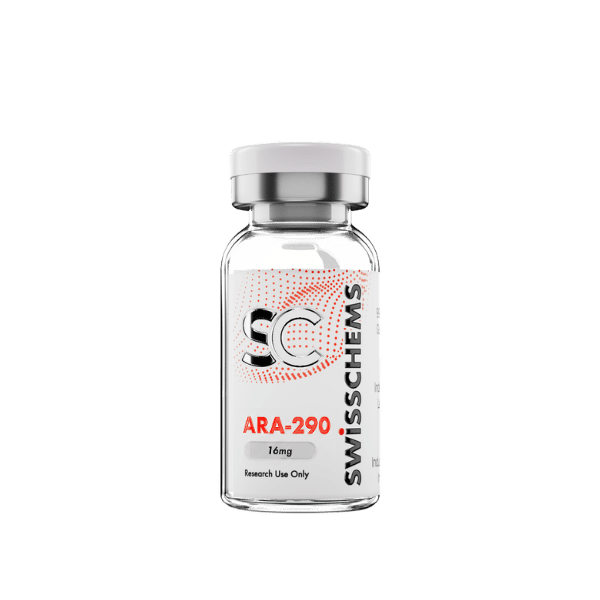
Cibinitide ARA-290 16mg
NOTE: In some cases wherein the assigned top colors are out of stock, a different top color will be used to ensure that your order will not be delayed.
Minimum Order: 1 Kit (10 vials)
Peptides are stable at room temperature and can be stored in their original packaging for several days to weeks. For longer storage, keep them at 4 °C or colder, away from intense light. Do not shake peptides before or after reconstitution, refrigerate them, and handle with care.
You can purchase BAC water here:
BAC 10ml
During our packaging transition, you may receive products with either our previous or updated label. Rest assured, the formulation, purity and quality remain exactly the same as per our standards.

Cibinitide (ARA-290) is a synthetic peptide engineered from a structural region of erythropoietin (EPO), designed to engage the innate repair receptor (IRR) — a heterodimeric receptor complex distinct from the classical homodimeric erythropoietin receptor responsible for erythropoiesis. Research interest centers on its capacity to activate IRR-mediated signalling without the haematopoietic effects associated with full EPO receptor engagement. Research applications include innate repair receptor pathway studies, cytoprotective signalling research, and EPO-derived peptide structure-activity investigation.
- High Purity – 99% Purity Guaranteed
- Independently Lab Tested
- Research Grade Quality
- For Laboratory Research Use Only
3D Molecular Structure
Drag to rotate · scroll to zoom| Chemical Formula | C51H84N16O21 |
|---|---|
| Synonyms | Cibinetide, PH-BSP, ARA290 |
| Molar Mass | 1257.31 g/mol |
| CAS Number | 1208243-50-8 |
| PubChem CID | 91810664 |
| Total Compound Content | 160mg (16mg per 1 vial) |
| Shelf Life | 36 months |
How does cibinitide's selectivity for the innate repair receptor distinguish it from native erythropoietin signaling?
Native erythropoietin activates the classical homodimeric EPO receptor to drive erythropoiesis (red blood cell production) in addition to other downstream effects. Cibinitide was engineered to selectively engage the innate repair receptor (IRR) — a distinct heterodimeric complex of the EPO receptor and the common beta receptor subunit (CD131) — without activating the homodimeric EPO receptor pathway responsible for erythropoietic effects. Research distinguishing these two signalling outcomes typically uses hematocrit or reticulocyte count as a readout for erythropoietic activity alongside IRR-specific signalling markers, to confirm selective IRR engagement without off-target erythropoietic stimulation.
What cell-based assays are used to study cibinitide's activation of innate repair receptor signaling?
Cell lines expressing the IRR complex (EPO receptor plus CD131) are used in receptor engagement and downstream signalling assays, typically measuring activation of JAK2/STAT5 or other cytoprotective signalling intermediates following cibinitide exposure, compared against cell lines expressing only the classical homodimeric EPO receptor to confirm receptor-complex-dependent selectivity. Inflammatory pathway readouts — such as NF-κB activation status or downstream cytokine production — are also used in models examining cibinitide's reported anti-inflammatory signalling effects.
What rodent injury models are used to study cibinitide's cytoprotective signaling effects?
Rodent models of tissue injury and inflammatory challenge — including peripheral nerve injury, ischemia-reperfusion injury models, and inflammatory pain models — have been used to study cibinitide's effects on cytoprotective and anti-inflammatory signalling pathways downstream of IRR activation. These studies typically combine behavioral or functional injury-recovery endpoints with tissue-level markers of inflammation and cell survival to characterise the peptide's pathway-specific effects in an intact physiological system.
-
-
SALE
-
-
SALE
-
-
SALE
-
-