Product Usage: This product is intended for research purposes only.
All product information available on this website is for educational purposes only. Any form of bodily introduction into humans or animals is strictly prohibited by law. This product should only be handled by licensed and qualified professionals. It is not a drug, food, or cosmetic, and must not be misbranded, misused, or mislabeled as such.
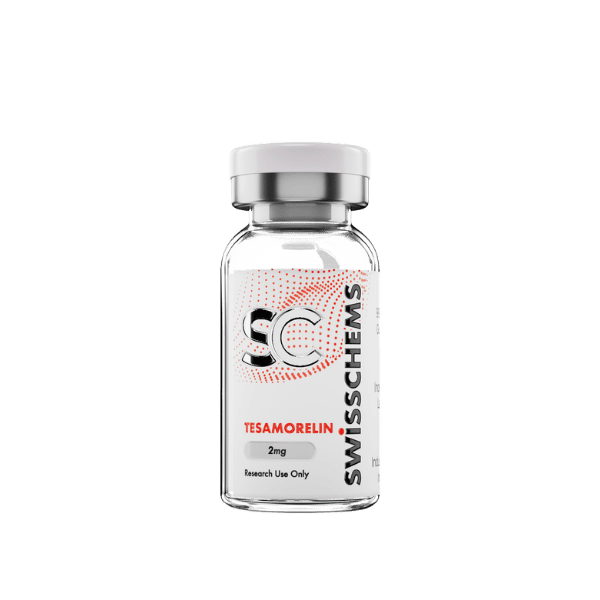
Tesamorelin, 2mg
During our packaging transition, you may receive products with either our previous or updated label. Rest assured, the formulation, purity and quality remain exactly the same as per our standards.

Tesamorelin 2 mg provides one individually sealed lyophilised vial of the synthetic GHRH analogue, suited for preclinical GH axis research, GHRHR agonist studies, and controlled laboratory protocols requiring a single 2 mg research vial.
Tesamorelin’s trans-3-hexenoic acid N-terminal modification confers DPP-IV resistance and an extended half-life of approximately 26–38 minutes compared to around 7 minutes for native GHRH, while preserving full GHRHR agonist activity. The single-vial format is suitable for smaller-scale experiments, pilot studies, or protocols that do not require a multi-vial kit.
- High Purity – 99% Purity Guaranteed
- Independently Lab Tested
- Research Grade Quality
- For Laboratory Research Use Only
3D Molecular Structure
Drag to rotate · scroll to zoom| Chemical Formula | C221H366N72O67S |
|---|---|
| Synonyms | TH9507, Egrifta (trade name) |
| Molar Mass | 5,135.86 g/mol |
| CAS Number | 218949-48-5 |
| PubChem CID | 16137828 |
| Total Compound Content | 20 mg total (10 × 2 mg vials) |
| Shelf Life | 36 months |
Tesamorelin 2 mg contains one lyophilised vial of research-grade synthetic GHRH analogue. It is designed for laboratory research involving GHRHR agonist activity, GH/IGF-1 axis signaling, and related preclinical study models.
Tesamorelin acts through GHRHR-mediated Gsα/cAMP/PKA signaling associated with growth hormone release. Its DPP-IV-resistant structure and extended plasma half-life of approximately 26–38 minutes make it useful for research protocols examining modified GHRH analogues and downstream GH/IGF-1 axis activation.
The single-vial format is particularly suited to exploratory studies, single-condition experiments, pilot protocols, or researchers who require a smaller quantity before scaling into larger study designs. Independently third-party HPLC-tested; COA available per batch.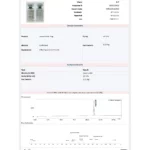
Why is matched-batch compound important for longitudinal Tesamorelin research studies?
Tesamorelin is a 44-amino-acid peptide whose biological activity depends on precise sequence integrity and correct folding post-reconstitution. Between-batch variation in peptide synthesis can produce minor differences in impurity profiles and residual protecting group content that may affect receptor activation kinetics. For longitudinal studies where baseline and endpoint measurements are separated by weeks or months, using matched-batch material from the same KIT eliminates inter-batch variation as a confounding variable — a methodological advantage relevant to studies measuring quantitative GHRHR pathway endpoints.
What is the recommended reconstitution volume for Tesamorelin 2 mg vials for preclinical use?
Reconstitution volume depends on the desired working concentration for the specific study design. A common laboratory approach is to reconstitute in 1–2 ml bacteriostatic water to produce a 1–2 mg/ml stock solution. For rodent studies, this is then diluted to the required dose in physiological saline or BAC water. Researchers should prepare only the volume needed for immediate use, as reconstituted peptide solutions are most stable within 24–48 hours at 4°C and should not be subjected to repeated freeze-thaw cycles.
What is Tesamorelin 2 mg used for in research?
Tesamorelin 2 mg is used in laboratory research involving growth hormone-releasing hormone receptor activity, GH/IGF-1 axis signaling, and related preclinical study models. It is intended strictly for research use only and is not for human consumption.
-
SALE
-
-
-
SALE

-
-
SALE
-