Product Usage: This product is intended for research purposes only.
All product information available on this website is for educational purposes only. Any form of bodily introduction into humans or animals is strictly prohibited by law. This product should only be handled by licensed and qualified professionals. It is not a drug, food, or cosmetic, and must not be misbranded, misused, or mislabeled as such.
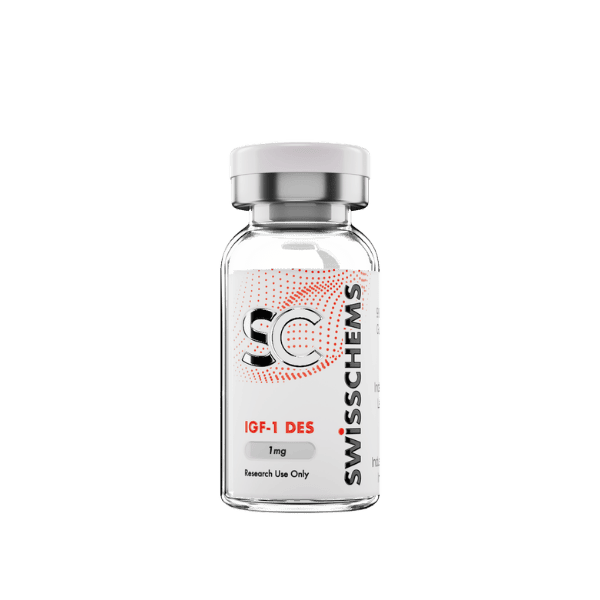
IGF-1 DES 1 mg
During our packaging transition, you may receive products with either our previous or updated label. Rest assured, the formulation, purity and quality remain exactly the same as per our standards.

IGF-1 DES (Des(1-3)IGF-1) is a naturally occurring, endogenous truncated form of IGF-1 lacking the first three N-terminal amino acids. This truncation reduces IGFBP affinity by approximately 10-fold relative to native IGF-1 while modestly increasing IGF-1 receptor binding potency. The shorter half-life and higher local potency of IGF-1 DES make it a useful research tool for studying IGF-1R activation dynamics distinct from the longer-acting IGF-1 LR3 analogue.
- High Purity – 99% Purity Guaranteed
- Independently Lab Tested
- Research Grade Quality
- For Laboratory Research Use Only
| Chemical Formula | C319H501N91O96S7 |
|---|---|
| Synonyms | IGF1 Human Des1-3; Insulin-Like Growth Factor 1 Des (1-3) Human Recombinant; Somatomedin C; IGF-I; IGFI; IGF1; IGF-IA; Des(1-3); Des1-3; Des 1-3; Des (1-3); IGF-1 (4-70); IGF1 Des1-3 |
| Molar Mass | 7,649 g/mol |
| CAS Number | 112603-35-7 |
| Total Compound Content | 1 mg per vial |
| Shelf Life | 36 months |
Every batch is independently lab tested for identity, purity and potency. View our lab testing program →
How does IGF-1 DES differ from IGF-1 LR3 in terms of receptor interaction characteristics?
IGF-1 DES and IGF-1 LR3 are structurally modified forms of IGF-1 that differ in their interactions with insulin-like growth factor binding proteins (IGFBPs) and their resulting receptor-accessibility profiles. IGF-1 DES utilizes N-terminal truncation, whereas IGF-1 LR3 incorporates amino acid substitution and sequence extension. These structural differences make both compounds useful research tools for investigating IGFBP interactions, ligand-receptor dynamics, and comparative IGF-1 receptor pharmacology.
What distinguishes IGF-1 DES from full-length IGF-1?
IGF-1 DES is a truncated analogue of IGF-1 in which the N-terminal region has been modified relative to the full-length peptide. This structural change alters its interaction characteristics while preserving high-affinity binding to the insulin-like growth factor 1 receptor (IGF-1R). As a result, IGF-1 DES is frequently used in studies examining structure-function relationships, receptor activation mechanisms, and the influence of peptide architecture on growth factor signaling pathways.
Why is IGF-1 DES useful for growth factor signaling research?
IGF-1 DES retains activation of key IGF-1R-mediated signaling pathways, including PI3K/Akt/mTOR and MAPK/ERK regulatory cascades. Its modified structure and distinct interaction profile make it a valuable research tool for investigating ligand-receptor interactions, growth factor signaling mechanisms, receptor pharmacology, and comparative studies of IGF-1 analogues and related signaling systems.
-
-
-
-
-
-
SALE