Product Usage: This product is intended for research purposes only.
All product information available on this website is for educational purposes only. Any form of bodily introduction into humans or animals is strictly prohibited by law. This product should only be handled by licensed and qualified professionals. It is not a drug, food, or cosmetic, and must not be misbranded, misused, or mislabeled as such.
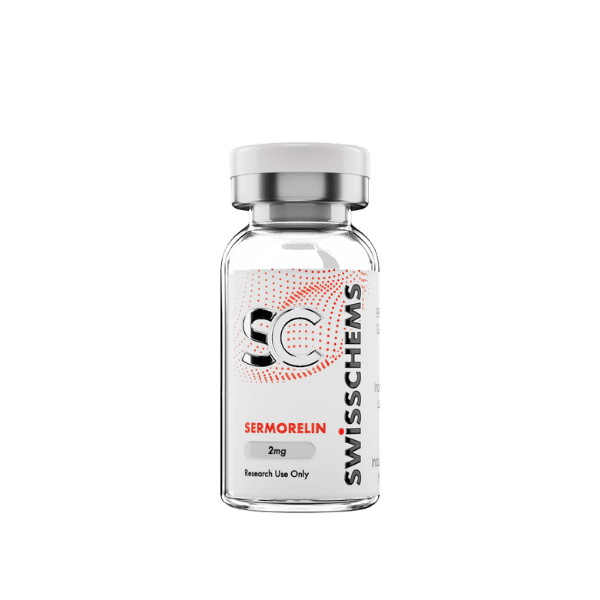
Sermorelin, 2mg
During our packaging transition, you may receive products with either our previous or updated label. Rest assured, the formulation, purity and quality remain exactly the same as per our standards.

Sermorelin (GRF 1–29) is a synthetic 29-amino-acid fragment of endogenous GHRH(1–44), representing the minimal active sequence required for full GHRHR agonist activity. GHRHR binding activates Gsα-coupled adenylyl cyclase, stimulating pulsatile GH release from anterior pituitary somatotrophs. Research applications include GHRHR pharmacology, somatotropic axis characterisation, and comparative GHRH analogue potency studies.
- High Purity – 99% Purity Guaranteed
- Independently Lab Tested
- Research Grade Quality
- For Laboratory Research Use Only
3D Molecular Structure
Drag to rotate · scroll to zoom| Chemical Formula | C151H250N44O44S |
|---|---|
| Synonyms | UNII-89243S03TE, 89243S03TE, Sermoreline, Sermorelinum, Growth Hormone Releasing Factor (GRF) (1-29) amide |
| Molar Mass | 3417.9 g/mol |
| CAS Number | 114466-38-5 |
| PubChem CID | 16132412 |
| Total Compound Content | 2 mg per vial |
| Shelf Life | 36 months |
What is the relationship between Sermorelin and endogenous GHRH?
Sermorelin is a synthetic 29-amino-acid fragment of the first 29 residues of endogenous human GHRH(1–44). Studies established that GHRH(1–29) retains full GHRHR agonist potency relative to the intact 44-residue peptide, as the N-terminal region contains the receptor-binding and activation domain. Sermorelin is therefore functionally equivalent to GHRH in terms of GHRHR pharmacology, though the shorter length confers a slightly shorter plasma half-life.
How does Sermorelin's half-life compare to other GHRH analogues used in research?
Sermorelin has a plasma half-life of approximately 10–20 minutes due to DPP-IV cleavage vulnerability. Tesamorelin (N-terminal trans-3-hexenoic acid modification) extends this to approximately 26–38 minutes. CJC-1295 without DAC (GRF 1–29) uses substitutions at positions 2, 8, 15, and 27 to provide DPP-IV resistance (t½ ~30 min), and CJC-1295 with DAC covalently binds albumin (t½ ~7–8 days). Sermorelin's shorter half-life makes it appropriate for studies requiring discrete, acute GH pulse induction.
Why is Sermorelin considered a reference compound in GHRHR research?
Sermorelin possesses one of the most extensively characterized pharmacological profiles among GHRHR agonists, with well-documented receptor binding properties, signaling activity, and ligand-receptor interaction data. Its defined structure, established receptor affinity, and thoroughly studied activation mechanisms have made it a widely used reference compound for investigations involving GHRHR pharmacology, receptor activation kinetics, structure-activity relationships, and comparative analyses of GHRH analogues. As a result, Sermorelin is frequently utilized as a benchmark molecule in studies examining receptor signaling, ligand optimization, and GHRHR-mediated signal transduction.
-
-
-
SALE

-
SALE
-
-
SALE
-