Product Usage: This product is intended for research purposes only.
All product information available on this website is for educational purposes only. Any form of bodily introduction into humans or animals is strictly prohibited by law. This product should only be handled by licensed and qualified professionals. It is not a drug, food, or cosmetic, and must not be misbranded, misused, or mislabeled as such.
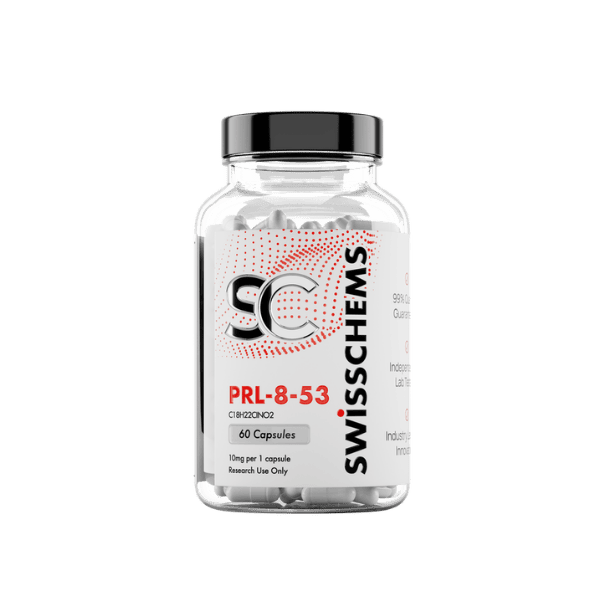
PRL-8-53
During our packaging transition, you may receive products with either our previous or updated label. Rest assured, the formulation, purity and quality remain exactly the same as per our standards.

PRL-8-53 (methyl 3-[2-[benzyl(methyl)amino]ethyl]benzoate hydrochloride) is a synthetic benzoate-class compound investigated for its interactions with monoaminergic signaling systems. Experimental studies have examined its effects on serotonergic and dopaminergic regulatory pathways, neurotransmitter-associated signaling mechanisms, receptor-ligand interactions, and molecular processes involved in synaptic communication. PRL-8-53 has been utilized in research exploring neurotransmitter modulation, signal transduction pathways, receptor-associated regulatory networks, and comparative pharmacological investigations of monoaminergic compounds. Its distinct chemical structure and proposed activity profile make it a valuable research tool for studies of serotonergic and dopaminergic signaling, neurotransmitter system regulation, and mechanistic investigations of monoamine-associated molecular pathways.
- High Purity – 99% Purity Guaranteed
- Independently Lab Tested
- Research Grade Quality
- For Laboratory Research Use Only
| Chemical Formula | C18H21NO2 |
|---|---|
| Synonyms | Methyl 3-[2-[benzyl(methyl)amino]ethyl]benzoate HCl |
| Molar Mass | 283.36 g/mol |
| CAS Number | 51352-87-5 |
| PubChem CID | 70700868 |
| Total Compound Content | 600 mg (10 mg per capsule) |
| Shelf Life | 36 months |
Every batch is independently lab tested for identity, purity and potency. View our lab testing program →
Why does PRL-8-53's chemical scaffold make it a candidate for monoamine system interaction studies despite limited mechanistic characterisation?
PRL-8-53 contains a benzoate core linked to a tertiary amine moiety, a structural arrangement frequently investigated in studies of monoaminergic signaling systems and neurotransmitter-associated pharmacology. Although its precise molecular targets remain incompletely characterized, its chemical architecture makes it a useful compound for investigations of structure-activity relationships, receptor-ligand interactions, transporter-associated mechanisms, and comparative pharmacological analyses within monoaminergic signaling networks.
What neurotransmitter system interactions have been proposed for PRL-8-53?
Experimental investigations have proposed potential interactions with serotonergic, dopaminergic, cholinergic, and broader monoaminergic signaling pathways. However, the precise molecular mechanisms responsible for these effects have not been definitively established through comprehensive receptor binding, transporter interaction, or enzyme kinetic studies. As a result, PRL-8-53 remains a compound of interest for mechanistic investigations aimed at clarifying its pharmacological targets and signaling properties.
What distinguishes PRL-8-53 from more extensively characterized research compounds?
PRL-8-53 is notable for the relatively limited mechanistic literature available compared with many extensively studied neurotransmitter-modulating compounds. This comparatively sparse characterization has made it a useful subject for exploratory pharmacological research, including studies of monoaminergic signaling, structure-activity relationships, receptor-associated regulatory pathways, and comparative investigations of compounds with proposed neurotransmitter system activity. Its incomplete mechanistic profile continues to provide opportunities for further investigation of its molecular targets and signaling mechanisms.
-
-
-
SALE