Product Usage: This product is intended for research purposes only.
All product information available on this website is for educational purposes only. Any form of bodily introduction into humans or animals is strictly prohibited by law. This product should only be handled by licensed and qualified professionals. It is not a drug, food, or cosmetic, and must not be misbranded, misused, or mislabeled as such.
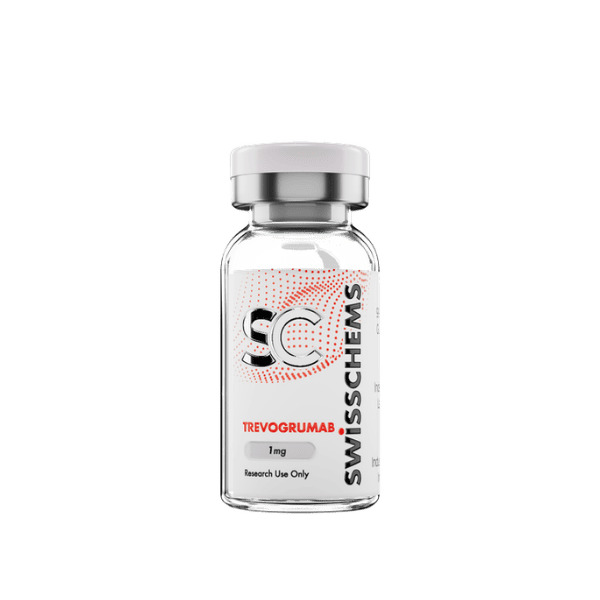
Trevogrumab 1mg
NOTE: In some cases wherein the assigned top colors are out of stock, a different top color will be used to ensure that your order will not be delayed.
Peptides are stable at room temperature and can be stored in their original packaging for several days to weeks. For longer storage, keep them at 4 °C or colder, away from intense light. Do not shake peptides before or after reconstitution, refrigerate them, and handle with care.
You can purchase BAC water here:
BAC 10ml
During our packaging transition, you may receive products with either our previous or updated label. Rest assured, the formulation, purity and quality remain exactly the same as per our standards.

Trevogrumab (REGN1033, SAR-391786) is a fully human monoclonal antibody engineered for high-affinity, selective neutralisation of myostatin (GDF-8), a TGF-beta superfamily ligand that functions as a primary negative regulator of skeletal muscle mass. Research interest centers on its specificity for myostatin without cross-reactivity to other ActRIIB-binding ligands such as activins or GDF-11. Research applications include myostatin pathway antagonist research, antibody-based ligand neutralisation studies, and comparative ActRIIB pathway inhibitor pharmacology.
- High Purity – 99% Purity Guaranteed
- Independently Lab Tested
- Research Grade Quality
- For Laboratory Research Use Only
3D Molecular Structure
Drag to rotate · scroll to zoom| Chemical Formula | C6374H9884N1696O2018S46 |
|---|---|
| Synonyms | REGN-1033 (REGN1033), Anti-GDF8/Myostatin antibody, SAR-391786 |
| CAS Number | 1429201-24-0 |
| PubChem CID | 384585220 |
| Total Compound Content | 1mg per vial |
| Shelf Life | 36 months |
Every batch is independently lab tested for identity, purity and potency. View our lab testing program →
How does Trevogrumab's myostatin selectivity distinguish it from broad-spectrum ActRIIB ligand traps in research?
Trevogrumab is engineered as a highly specific anti-myostatin (GDF-8) antibody, binding myostatin directly to prevent its engagement of ActRIIB, with minimal cross-reactivity to other TGF-beta superfamily ligands. This contrasts with soluble ActRIIB-Fc fusion protein ligand traps, which sequester myostatin alongside activins, GDF-11, and BMP-9/10 indiscriminately. For research questions requiring isolation of myostatin-specific pathway contributions — without confounding effects from co-inhibited activin or BMP signalling — trevogrumab's selective mechanism is the appropriate experimental tool.
What assay formats are used to confirm Trevogrumab's neutralizing potency against myostatin-induced signaling?
Cell-based Smad2/3 reporter assays — using myoblast cell lines such as C2C12 transfected with a Smad-responsive luciferase construct — are standard for quantifying trevogrumab's capacity to block myostatin-induced Smad2/3 transcriptional activation in a dose-dependent manner, typically expressed as an IC50 or neutralising dose. Surface plasmon resonance (SPR) or other direct binding-affinity methods are used in parallel to characterise trevogrumab's intrinsic binding kinetics (Kd, on/off rates) to recombinant myostatin independent of the cell-based functional readout.
What rodent model endpoints are used to evaluate Trevogrumab's functional effects on skeletal muscle mass?
Rodent studies investigating myostatin pathway antagonists typically measure lean body mass and individual muscle wet weight (e.g. gastrocnemius, quadriceps) following a defined dosing period, alongside functional measures such as grip strength or treadmill exercise capacity. These studies often include muscle fiber cross-sectional area histology to confirm hypertrophy at the cellular level, and serum myostatin/antibody pharmacokinetic sampling to correlate systemic drug exposure with the magnitude of the observed muscle-mass phenotype.
-
-
-
-
SALE
-
-