Product Usage: This product is intended for research purposes only.
All product information available on this website is for educational purposes only. Any form of bodily introduction into humans or animals is strictly prohibited by law. This product should only be handled by licensed and qualified professionals. It is not a drug, food, or cosmetic, and must not be misbranded, misused, or mislabeled as such.
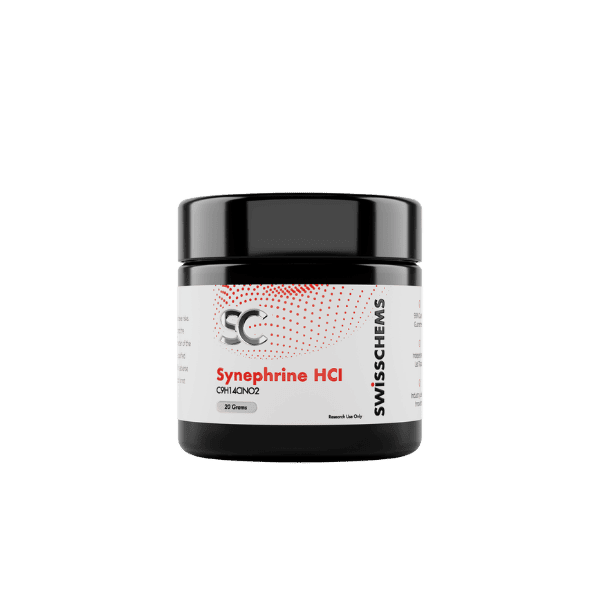
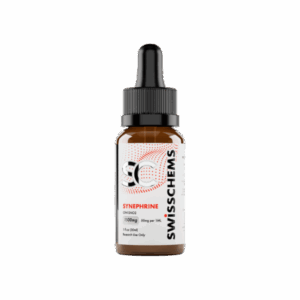
Synephrine HCl – Powder, 20 grams
During our packaging transition, you may receive products with either our previous or updated label. Rest assured, the formulation, purity and quality remain exactly the same as per our standards.

Synephrine HCl is the hydrochloride salt form of synephrine, a phenylethanolamine compound studied for its interactions with adrenergic receptor subtypes, with particular research interest in beta-3 adrenergic receptor selectivity relative to other adrenergic agonist compounds. The hydrochloride formulation improves aqueous solubility and stability for precision-based research applications. Research applications include adrenergic receptor subtype selectivity studies, salt-form pharmacokinetic comparison, and comparative phenylethanolamine pharmacology.
- High Purity – 99% Purity Guaranteed
- Independently Lab Tested
- Research Grade Quality
- For Laboratory Research Use Only
3D Molecular Structure
Drag to rotate · scroll to zoom| Chemical Formula | C9H14ClNO2 |
|---|---|
| Synonyms | 4-(1-Hydroxy-2-(methylamino)ethyl)phenol hydrochloride, Oxedrine hydrochloride, Synephrine (hydrochloride), MFCD00050566, Ocuton (TN) |
| Molar Mass | 203.66 g/mol |
| CAS Number | 5985-28-4 |
| PubChem CID | 42609626 |
| Total Compound Content | 20 grams |
| Shelf Life | 36 months |
Every batch is independently lab tested for identity, purity and potency. View our lab testing program →
How does the hydrochloride salt form of synephrine differ from the free base in solubility and research handling?
The hydrochloride salt confers substantially improved aqueous solubility and dissolution rate compared to the free-base form, making it more practical for preparing reproducible stock solutions for in vitro receptor-binding assays and aqueous-vehicle rodent dosing protocols. Researchers should account for the additional mass contribution of the chloride counter-ion when converting between mass-based and molar-based dosing calculations across studies using different salt forms.
What metabolic pathways are studied for synephrine HCl clearance in pharmacokinetic research?
Synephrine HCl is studied as undergoing hepatic metabolism primarily via monoamine oxidase (MAO)-mediated oxidative deamination and phase II sulfation conjugation, with the resulting metabolites cleared predominantly through renal excretion. Pharmacokinetic studies characterising these pathways typically use MAO inhibitor co-administration to isolate the contribution of oxidative versus conjugative metabolism to overall clearance, informing dose-timing and metabolite-monitoring decisions in longer-duration in vivo protocols.
Why might researchers select the hydrochloride salt powder format over the pre-made solution format for synephrine studies?
Powder format allows researchers to prepare custom-concentration stock solutions tailored to their specific solvent system and required final concentration range, offering greater flexibility for dose-response curve generation than a single fixed-concentration solution product. This is particularly relevant for in vitro receptor-binding assays requiring a wide concentration range to establish full dose-response curves, or for studies requiring a non-aqueous solvent system not compatible with a pre-formulated aqueous solution.