Product Usage: This product is intended for research purposes only.
All product information available on this website is for educational purposes only. Any form of bodily introduction into humans or animals is strictly prohibited by law. This product should only be handled by licensed and qualified professionals. It is not a drug, food, or cosmetic, and must not be misbranded, misused, or mislabeled as such.
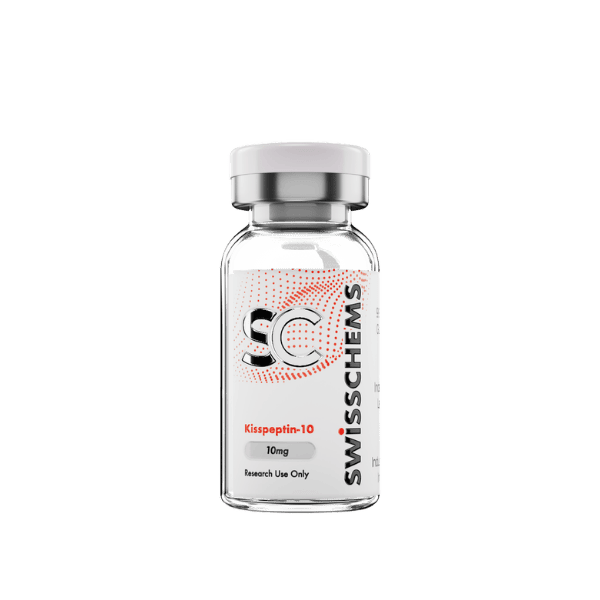
Kisspeptin-10 10mg
During our packaging transition, you may receive products with either our previous or updated label. Rest assured, the formulation, purity and quality remain exactly the same as per our standards.

Kisspeptin-10 (KP-10) is the C-terminal 10-amino-acid biologically active fragment of kisspeptin (metastin), the endogenous ligand for GPR54 (KISS1R). GPR54 activation by kisspeptin-10 in hypothalamic KNDy neurons potently stimulates GnRH pulse release, positioning it as the master upstream regulator of the HPG axis. Research applications include GPR54 pharmacology, GnRH pulsatility investigation, KNDy neuron circuitry research, and HPG-axis neuroendocrinology.
- High Purity – 99% Purity Guaranteed
- Independently Lab Tested
- Research Grade Quality
- For Laboratory Research Use Only
3D Molecular Structure
Drag to rotate · scroll to zoom| Chemical Formula | C258H401N79O78 |
|---|---|
| Synonyms | KISS-1 (68-121), Protein KISS-1, Gene KISS1 protein |
| Molar Mass | 5857 g/mol |
| CAS Number | 388138-21-4 |
| PubChem CID | 71306396 |
| Total Compound Content | 10 mg per vial |
| Shelf Life | 36 months |
What is the significance of kisspeptin in regulating the GnRH pulse generator?
Kisspeptin (via GPR54 activation on GnRH neurons) is the most potent known endogenous stimulator of GnRH pulsatility. Its identification in 2003 resolved a decades-long question about the upstream regulator of GnRH neurons — previously, the identity of the GnRH 'pulse generator' was unknown. KNDy neurons (co-expressing kisspeptin, NKB, and dynorphin) in the arcuate nucleus are now understood to generate the GnRH pulse signal, with kisspeptin as the primary GnRH secretagogue and NKB/dynorphin providing autocrine synchronisation. KP-10 is the research tool for directly activating this pathway.
How does kisspeptin-10 differ from full-length kisspeptin in research applications?
Full-length human kisspeptin-54 (hKP-54) and the shorter fragments KP-13 and KP-10 all bind GPR54 and stimulate GnRH release. KP-10 (the C-terminal decapeptide) retains the RF-amide motif essential for GPR54 binding and is equipotent with longer forms at the receptor. Its shorter length confers easier synthetic preparation, more consistent purity, and straightforward HPLC verification. KP-10 is the most widely used kisspeptin research tool in the published literature due to these practical advantages.
Why does kisspeptin-10's very short plasma half-life complicate research protocol design?
Kisspeptin-10 has a plasma half-life of approximately 3 minutes due to rapid C-terminal cleavage by endopeptidase 24.11 (neprilysin) and other peptidases. This necessitates continuous infusion or frequent bolus injections to maintain sustained GPR54 activation and GnRH stimulation in in vivo research. For studies requiring acute GnRH pulse stimulation, a single bolus is appropriate. For studies modelling tonic kisspeptin signalling (e.g. pubertal timing, continuous HPG axis activation), researchers must use infusion protocols or longer-acting kisspeptin analogues engineered for peptidase resistance.
-
-
-
SALE

-
-
-
SALE
-
SALE