Product Usage: This product is intended for research purposes only.
All product information available on this website is for educational purposes only. Any form of bodily introduction into humans or animals is strictly prohibited by law. This product should only be handled by licensed and qualified professionals. It is not a drug, food, or cosmetic, and must not be misbranded, misused, or mislabeled as such.
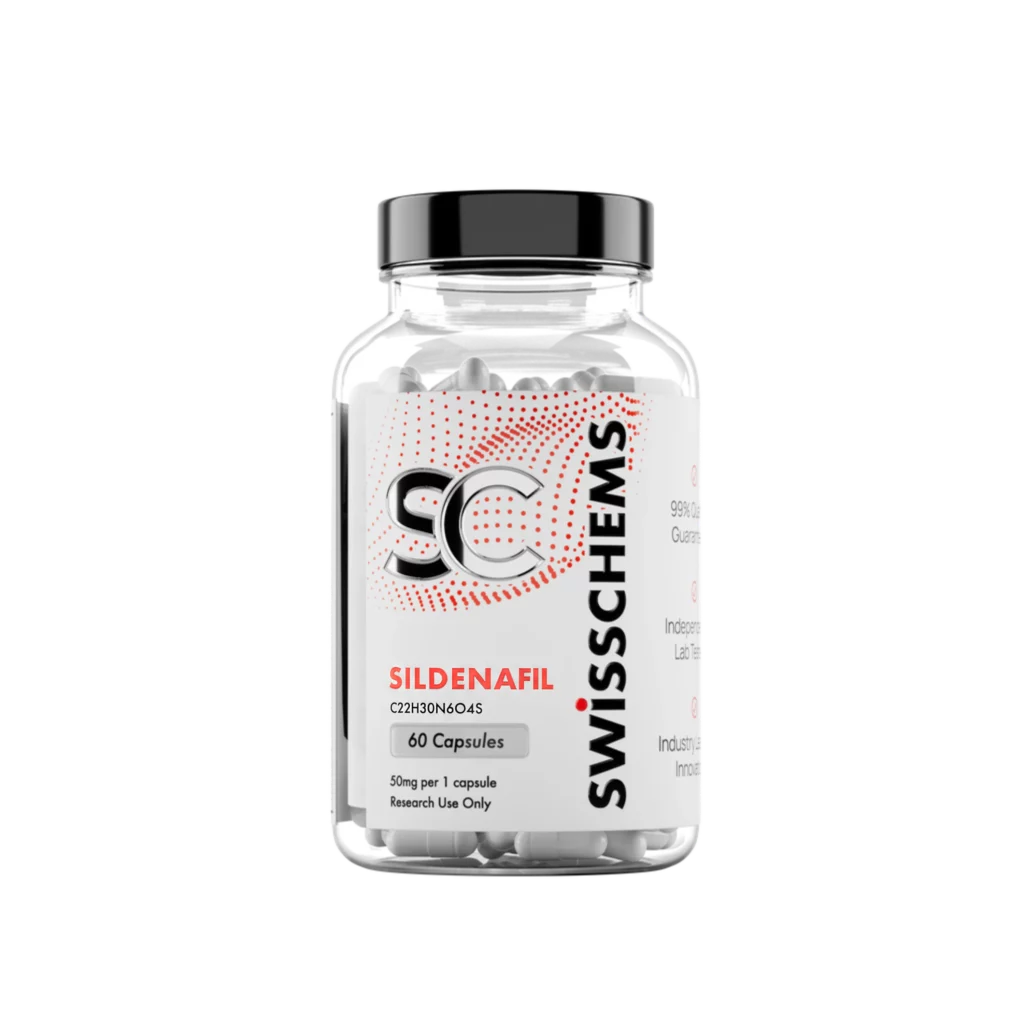
Sildenafil, (50mg/capsule), 60 Capsules
During our packaging transition, you may receive products with either our previous or updated label. Rest assured, the formulation, purity and quality remain exactly the same as per our standards.

Sildenafil is a selective phosphodiesterase type 5 (PDE5) inhibitor that modulates cyclic guanosine monophosphate (cGMP) signaling by preventing PDE5-mediated cGMP degradation. Inhibition of PDE5 increases intracellular cGMP availability, enhancing downstream protein kinase G (PKG) signaling and other cGMP-dependent molecular pathways. Experimental investigations have utilized sildenafil in studies of nitric oxide (NO)/cGMP signaling, phosphodiesterase enzyme kinetics, cyclic nucleotide regulation, signal transduction mechanisms, and comparative PDE inhibitor pharmacology. Its well-characterized selectivity profile and established mechanism of action make sildenafil a valuable research tool for investigations of PDE5 biology, cGMP-mediated signaling networks, enzyme inhibition dynamics, and cyclic nucleotide-dependent molecular processes.
- High Purity – 99% Purity Guaranteed
- Independently Lab Tested
- Research Grade Quality
- For Laboratory Research Use Only
3D Molecular Structure
Drag to rotate · scroll to zoom| Chemical Formula | C22H30N6O4S |
|---|---|
| Synonyms | UK-92,480 |
| Molar Mass | 474.58 g/mol |
| CAS Number | 139755-83-2 |
| PubChem CID | 135398744 |
| Total Compound Content | 3,000 mg (50 mg per capsule) |
| Shelf Life | 36 months |
Every batch is independently lab tested for identity, purity and potency. View our lab testing program →
What is the mechanistic basis for PDE5 inhibition amplifying cGMP signaling?
Nitric oxide (NO) activates soluble guanylyl cyclase (sGC), which catalyzes the conversion of GTP to cyclic guanosine monophosphate (cGMP). Elevated cGMP subsequently activates protein kinase G (PKG) and other cGMP-dependent signaling pathways. PDE5 is the primary enzyme responsible for cGMP hydrolysis in numerous experimental systems. By competitively inhibiting PDE5, sildenafil reduces cGMP degradation, resulting in prolonged and amplified cGMP-dependent signal transduction. This mechanism makes sildenafil a valuable research tool for investigations of NO/sGC/cGMP pathway dynamics, cyclic nucleotide signaling, and PDE5-mediated regulatory mechanisms.
What is the selectivity profile of sildenafil across phosphodiesterase isoforms, and why is PDE6 cross-reactivity important?
Sildenafil exhibits high selectivity for PDE5 relative to most phosphodiesterase isoforms, including PDE1, PDE2, PDE3, and PDE4. However, selectivity over PDE6 is substantially lower. PDE6 is a cGMP-specific phosphodiesterase involved in phototransduction signaling pathways, making sildenafil's PDE6 activity useful in studies examining phosphodiesterase subtype selectivity, cyclic nucleotide signaling, and comparative enzyme pharmacology. This differential selectivity profile has established sildenafil as a valuable reference compound for investigations of PDE family structure-function relationships.
Why is sildenafil considered a reference compound in PDE5 pharmacology research?
Sildenafil is among the most extensively characterized PDE5 inhibitors available, with well-defined enzyme kinetics, selectivity profiles, pharmacodynamic properties, and molecular mechanisms. Its potent and selective inhibition of PDE5, combined with extensive experimental characterization, makes it a benchmark compound for studies of phosphodiesterase biology, cyclic nucleotide regulation, enzyme inhibition kinetics, signal transduction mechanisms, and comparative evaluation of novel PDE inhibitors.
-
SALE
-
-
SALE
-
-
-
-
SALE
-