Product Usage: This product is intended for research purposes only.
All product information available on this website is for educational purposes only. Any form of bodily introduction into humans or animals is strictly prohibited by law. This product should only be handled by licensed and qualified professionals. It is not a drug, food, or cosmetic, and must not be misbranded, misused, or mislabeled as such.
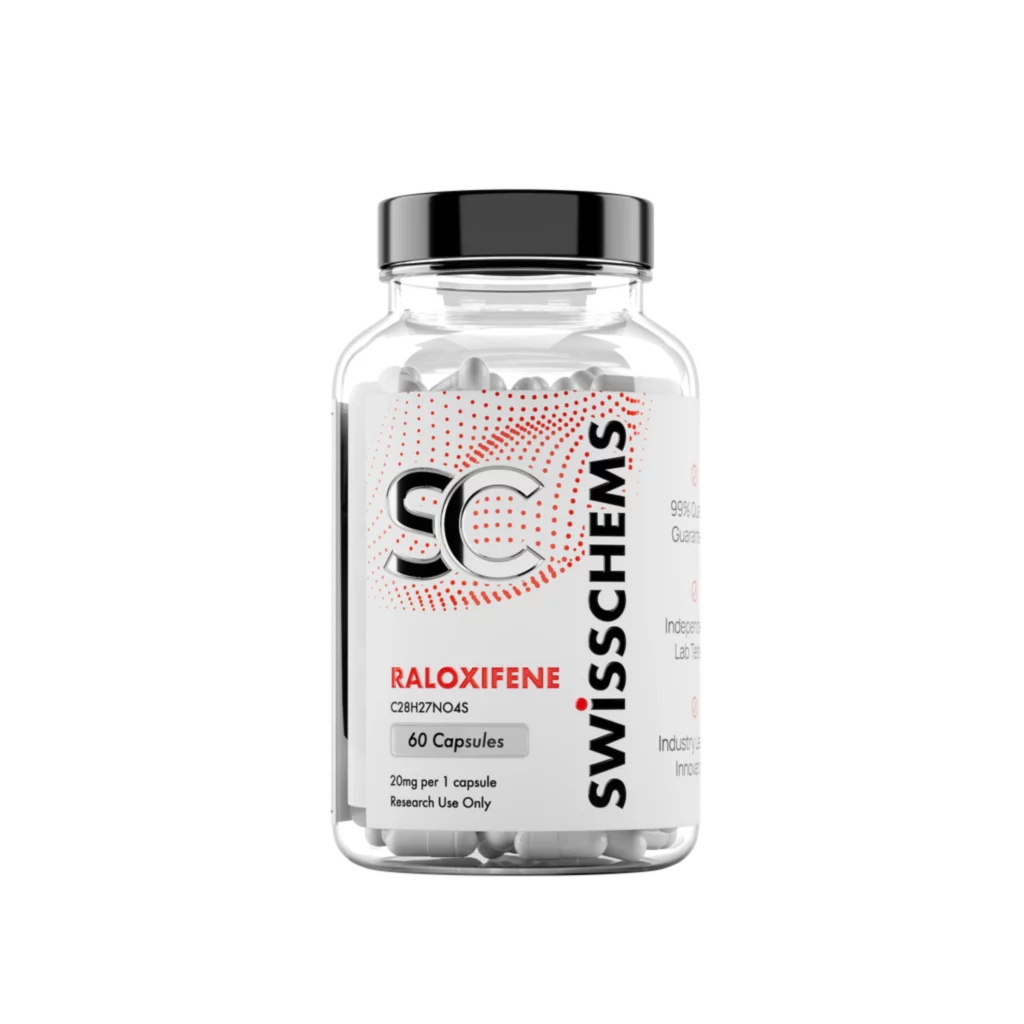
Raloxifene (20mg/capsule), 60 Capsules
During our packaging transition, you may receive products with either our previous or updated label. Rest assured, the formulation, purity and quality remain exactly the same as per our standards.

Raloxifene is a selective estrogen receptor modulator (SERM) that exhibits tissue-specific agonist and antagonist activity at estrogen receptors (ERs). It interacts with ERα and ERβ, influencing gene transcription and receptor-mediated signaling pathways.
This compound undergoes hepatic metabolism primarily via glucuronidation, producing inactive glucuronide conjugates.
- High Purity – 99% Purity Guaranteed
- Independently Lab Tested
- Research Grade Quality
- For Laboratory Research Use Only
3D Molecular Structure
Drag to rotate · scroll to zoom| Chemical Formula | C28H27NO4S |
|---|---|
| Synonyms | Keoxifene, LY156758 |
| Molar Mass | 473.58 g/mol |
| CAS Number | 84449-90-1 |
| PubChem CID | 5035 |
| Total Compound Content | 5 grams |
| Shelf Life | 36 months |

What makes raloxifene's tissue selectivity distinct from tamoxifen's in receptor pharmacology research?
Both compounds bind the estrogen receptor, but the resulting receptor conformation differs in ways that alter coactivator/corepressor recruitment by tissue. Raloxifene's conformation favors antagonist activity in both breast and endometrial tissue, whereas tamoxifen retains partial agonist activity in the endometrium. This divergence makes head-to-head SERM studies a common approach for mapping how structural differences in ligands translate into tissue-specific transcriptional outcomes.
How is raloxifene used in bone metabolism research models?
Because raloxifene's receptor conformation in bone tissue favors estrogen-agonist-like signaling, it is used in osteoblast/osteoclast culture models and in vivo bone density studies to examine estrogen-receptor-mediated effects on bone turnover, independent of the antagonist activity it shows in reproductive tissue.
What distinguishes raloxifene's metabolic pathway from other SERMs in pharmacokinetic research?
Raloxifene undergoes extensive glucuronidation rather than requiring CYP2D6-mediated bioactivation, unlike tamoxifen, which depends on CYP2D6 conversion to its active metabolite endoxifen. This makes raloxifene a useful comparator in research examining how metabolic activation requirements affect SERM activity and inter-individual variability tied to CYP2D6 polymorphisms.
-
SALE
-

-
SALE
-
SALE

-
-
SALE

-
SALE

-
SALE