Product Usage: This product is intended for research purposes only.
All product information available on this website is for educational purposes only. Any form of bodily introduction into humans or animals is strictly prohibited by law. This product should only be handled by licensed and qualified professionals. It is not a drug, food, or cosmetic, and must not be misbranded, misused, or mislabeled as such.
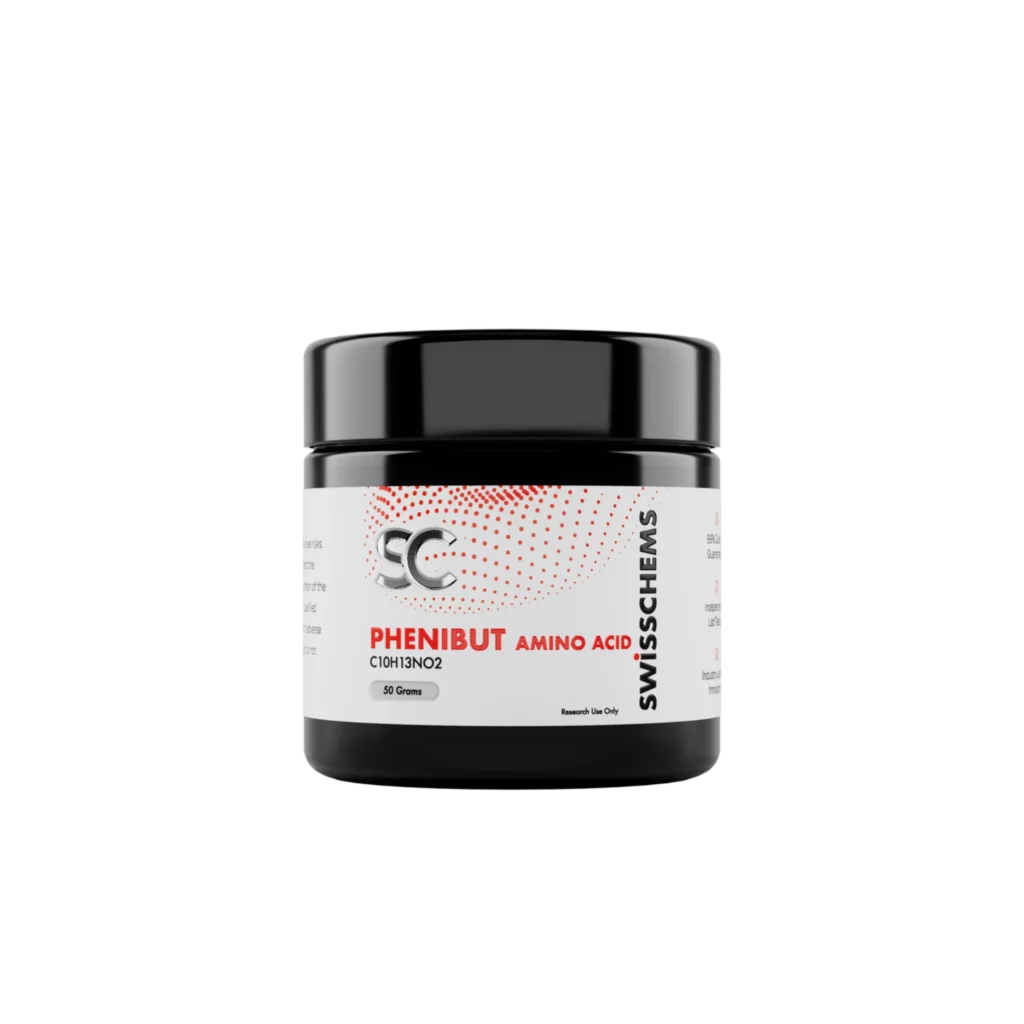
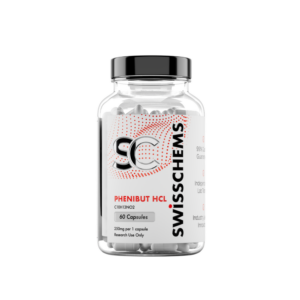
Phenibut Free Amino Acid – Powder, 50 grams
During our packaging transition, you may receive products with either our previous or updated label. Rest assured, the formulation, purity and quality remain exactly same as standards.

Phenibut Free Amino Acid (FAA) is the free base form of β-phenyl-γ-aminobutyric acid, distinct from Phenibut HCL in that it lacks the hydrochloride salt component. The free base form has lower molecular weight, different solubility characteristics, and is used in research applications requiring non-salt formulations. It retains the same GABA-B receptor agonist and GABA-A ρ modulator pharmacological profile as the HCL form.
- High Purity – 99% Purity Guaranteed
- Independently Lab Tested
- Research Grade Quality
- For Laboratory Research Use Only
3D Molecular Structure
Drag to rotate · scroll to zoom| Chemical Formula | C10H13NO2 |
|---|---|
| Synonyms | β-Phenyl-GABA (free base), γ-Amino-β-phenylbutyric acid, Fenibut |
| Molar Mass | 179.219 g/mol |
| CAS Number | 1078-21-3 |
| PubChem CID | 14113 |
| Total Compound Content | 50 g powder |
| Shelf Life | 36 months |
Every batch is independently lab tested for identity, purity and potency. View our lab testing program →
What is the practical difference between Phenibut HCL and Phenibut Free Amino Acid for research use?
The primary differences are solubility and formulation compatibility. Phenibut HCL is highly water-soluble (~200 mg/mL) and suited to aqueous solution preparation. Phenibut Free Amino Acid (free base) has lower water solubility (~10–15 mg/mL) but higher solubility in organic solvents and lipophilic vehicles. The free base form is preferred for lipophilic formulations, sublingual preparations, or when chloride ions from the HCL salt would confound the assay. Pharmacological activity is equivalent once dissolved; the choice is driven by formulation requirements.
Does the free amino acid form have different pharmacokinetics than the HCL salt?
Once absorbed, both forms deliver the same active moiety (β-phenyl-GABA) to the systemic circulation. The salt form has no independent pharmacological activity — the HCl component dissociates in solution. Any pharmacokinetic differences relate to dissolution rate and absorption site pH dynamics rather than inherent compound differences. In vivo, both forms are expected to produce equivalent plasma concentration profiles at equimolar doses when formulated appropriately.
At what pH does phenibut free amino acid become ionised, and how does this affect solubility?
Phenibut has a pKa of approximately 4.1 (carboxylic acid) and 9.4 (amino group). At physiological pH (~7.4), it exists predominantly in its zwitterionic form. The free base powder is in its neutral/free base state, which has lower water solubility than the protonated HCL salt form. Solubility increases significantly below pH 5, where protonation of the amino group occurs. This pH-dependent solubility is relevant to in vitro assay design when working in acidic culture conditions or buffer systems.