Product Usage: This product is intended for research purposes only.
All product information available on this website is for educational purposes only. Any form of bodily introduction into humans or animals is strictly prohibited by law. This product should only be handled by licensed and qualified professionals. It is not a drug, food, or cosmetic, and must not be misbranded, misused, or mislabeled as such.
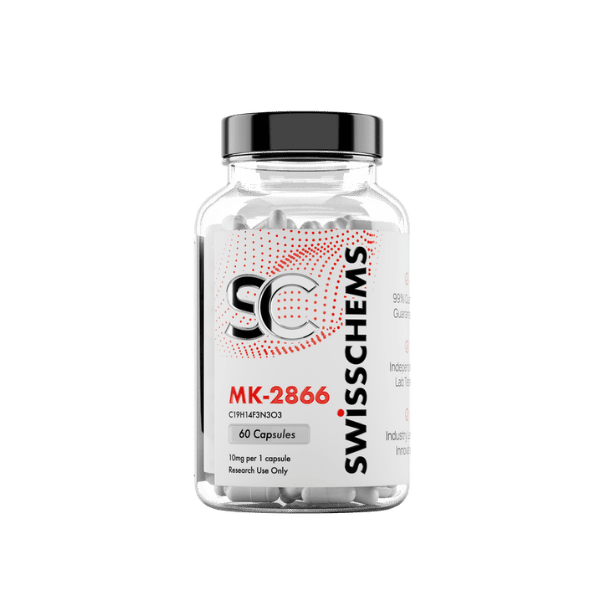
Ostarine (MK-2866), (10mg/capsule), 60 Capsules
During our packaging transition, you may receive products with either our previous or updated label. Rest assured, the formulation, purity and quality remain exactly the same as per our standards.

Ostarine (MK-2866), also designated enobosarm and GTx-024, is a non-steroidal selective androgen receptor modulator (SARM) of the arylpropionamide class. Binding studies of its parent series report low-nanomolar androgen receptor (AR) affinity, and rodent models document selective activity in anabolic tissues at very low dose rates. Enobosarm is the most clinically advanced arylpropionamide SARM, with published randomised Phase II data on lean body mass, physical function and AR-positive breast cancer. Research applications include AR pharmacology, tissue-selective anabolic signalling, muscle and bone models, and comparative SARM studies.
- High Purity – 99% Purity Guaranteed
- Independently Lab Tested
- Research Grade Quality
- For Laboratory Research Use Only
3D Molecular Structure
Drag to rotate · scroll to zoom| Chemical Formula | C19H14F3N3O3 |
|---|---|
| Synonyms | (2S)-3-(4-cyanophenoxy)-N-[4-cyano-3-(trifluoromethyl)phenyl]-2-hydroxy-2-methylpropanamide, Enobosarm, GTx-024, S-22, MK-2866 |
| Molar Mass | 389.3 g/mol |
| CAS Number | 841205-47-8 |
| Pubchem CID | 11326715 |
| Total Compound Content | 600 mg (10 mg per capsule) |
| Shelf Life | 36 months |
Are Ostarine, MK-2866, enobosarm and GTx-024 the same compound?
Yes. They are names for the same molecule, (2S)-3-(4-cyanophenoxy)-N-[4-cyano-3-(trifluoromethyl)phenyl]-2-hydroxy-2-methylpropanamide (CAS 841205-47-8). S-22 was its designation in the original structure–activity series [1], GTx-024 and MK-2866 are development codes, and enobosarm is the adopted generic name [13]. Enobosarm has no FDA-approved indication and remains an investigational compound [14].
What is the half-life of Ostarine and how is it cleared?
In rats, elimination half-life shows a pronounced sex difference: 0.6 h in males and 16.4 h in females. Clearance is mainly fecal, with most of the dose excreted unchanged [2]. Human Phase I interaction data identify GTx-024 glucuronide as the major circulating metabolite. Exposure was unaffected by CYP3A4 inhibition and increased by UGT inhibition, which points to glucuronidation as a key clearance pathway [4]. Researchers comparing results across rodent studies should account for the sex difference in exposure.
How does Ostarine compare with RAD-140 and LGD-4033 in androgen receptor research?
All three are non-steroidal AR ligands, but they come from different chemical classes: Ostarine is an arylpropionamide, RAD-140 an oxadiazole and LGD-4033 a pyrrolidinyl-benzonitrile. Ostarine has the largest published clinical dataset of the three, including multiple randomised Phase II trials [5, 6, 7]. That dataset makes it a common reference compound when characterising new SARMs or comparing tissue selectivity across scaffolds [3].
Why does batch-level identity and purity testing matter for SARM research?
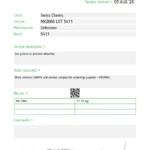
A JAMA analysis of 44 products sold online as SARMs found that only 52% contained any SARM, 25% contained substances not listed on the label and only 41% contained the labelled amount of active compound [15]. Without confirmed identity and content, results from an experiment cannot be attributed to the compound. Every SwissChems batch is independently third-party HPLC-tested, and the COA is published under the Lab Results tab.
-
SALE
-
SALE
-
-
SALE
-
SALE
-
-
-