Product Usage: This product is intended for research purposes only.
All product information available on this website is for educational purposes only. Any form of bodily introduction into humans or animals is strictly prohibited by law. This product should only be handled by licensed and qualified professionals. It is not a drug, food, or cosmetic, and must not be misbranded, misused, or mislabeled as such.
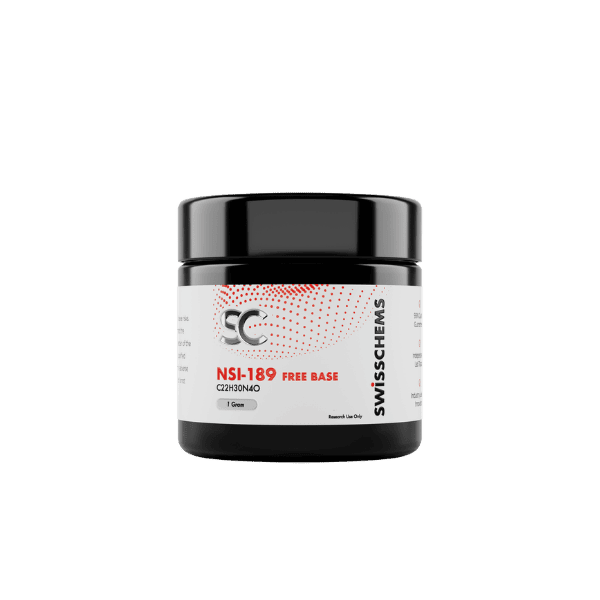
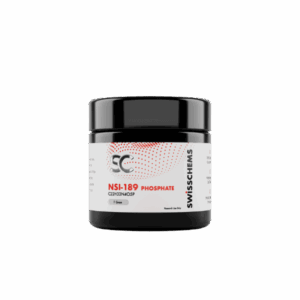
NSI-189 Free Base – Powder, 1 gram
During our packaging transition, you may receive products with either our previous or updated label. Rest assured, the formulation, purity and quality remain exactly the same as per our standards.

NSI-189 free base is a synthetic benzylpiperazine-aminopyridine derivative investigated for its effects on neural progenitor cell proliferation and neurogenesis-associated pathways. Research has focused on progenitor cell expansion, neuronal differentiation markers, and intracellular signalling mechanisms distinct from classical monoaminergic compounds. Applications include neural progenitor proliferation assays, neurogenesis biomarker studies, and structure-activity relationship (SAR) research. The free-base powder format supports flexible stock-solution preparation and precise concentration-response studies.
- High Purity – 99% Purity Guaranteed
- Independently Lab Tested
- Research Grade Quality
- For Laboratory Research Use Only
3D Molecular Structure
Drag to rotate · scroll to zoom| Chemical Formula | C22H30N4O |
|---|---|
| Synonyms | 270138-41-4 UNII-HX0VO60T62 HX0VO60T62 |
| Molar Mass | 366.5 g/mol |
| CAS Number | 1270138-40-3 |
| PubChem CID | 50922681 |
| Total Compound Content | 1 gram |
| Shelf Life | 36 months |
Every batch is independently lab tested for identity, purity and potency. View our lab testing program →
How does the free-base format differ from the phosphate salt in solution preparation?
Free-base compounds do not contain the counter-ion present in salt forms, which can influence solubility, dissolution characteristics, and final solution pH. Selection between free-base and phosphate formats depends on the solvent system, assay requirements, and desired formulation conditions. When preparing solutions, molar concentration calculations should account for differences in molecular weight between the free base and salt forms.
What should be considered when comparing data generated using free-base versus phosphate formulations?
Comparisons should be normalized to the molar amount of the active compound rather than total mass, since salt forms contain additional molecular weight from the counter-ion. This approach allows direct comparison of concentration-response data across studies using different formulations of the same compound.
What solubility considerations apply to NSI-189 free base?
Free-base compounds may exhibit different aqueous solubility profiles than corresponding salt forms and can require co-solvents or adjusted solution conditions to achieve complete dissolution. Researchers should verify solubility at intended working concentrations and confirm the absence of precipitation before use in cell-based assays or preclinical research protocols.