Product Usage: This product is intended for research purposes only.
All product information available on this website is for educational purposes only. Any form of bodily introduction into humans or animals is strictly prohibited by law. This product should only be handled by licensed and qualified professionals. It is not a drug, food, or cosmetic, and must not be misbranded, misused, or mislabeled as such.
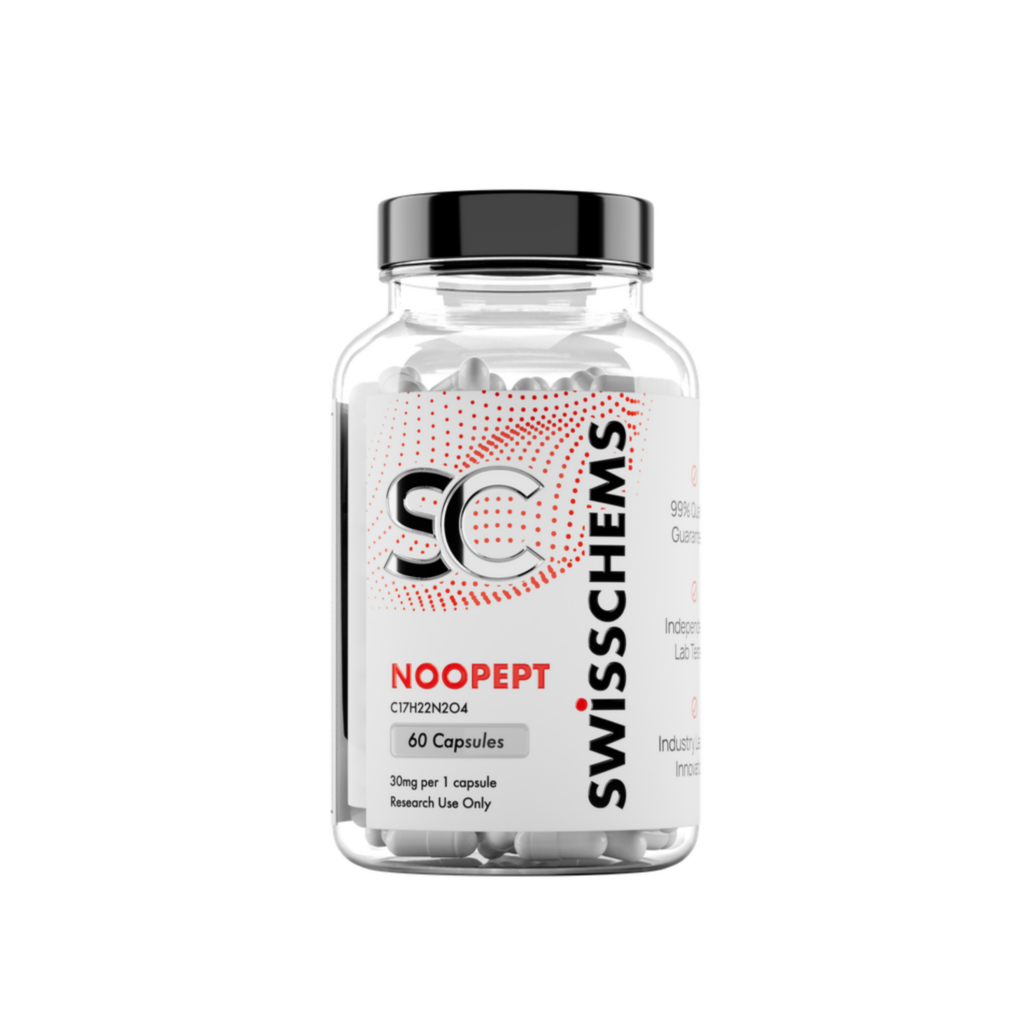
Noopept (Omberacetam), (30mg/capsule), 60 Capsules
During our packaging transition, you may receive products with either our previous or updated label. Rest assured, the formulation, purity and quality remain exactly same as standards.

Noopept (Omberacetam) is a synthetic dipeptide analog of the racetam family, known for its role in glutamatergic and cholinergic signaling pathways. It exhibits high affinity for AMPA and NMDA receptors, contributing to its involvement in synaptic transmission and neurochemical interactions.
This compound undergoes rapid hydrolysis into bioactive peptide fragments, facilitating its metabolic activity. Noopept is processed through hepatic oxidation and conjugation, with primary clearance occurring via renal excretion.
- High Purity – 99% Purity Guaranteed
- Independently Lab Tested
- Research Grade Quality
- For Laboratory Research Use Only
3D Molecular Structure
Drag to rotate · scroll to zoomEvery batch is independently lab tested for identity, purity and potency. View our lab testing program →
What is cycloprolylglycine and why is Noopept considered its prodrug?
Cycloprolylglycine (cPG) is a cyclic dipeptide investigated in studies of peptide-mediated signaling systems and receptor-associated regulatory pathways. Noopept undergoes biotransformation to yield cPG as a principal metabolite, making it a useful research tool for examining prodrug conversion mechanisms, metabolite-associated pharmacology, and the relationship between parent compounds and biologically active peptide derivatives. This prodrug relationship distinguishes Noopept from compounds that act exclusively through direct receptor interactions.
How does Noopept differ from racetam-class compounds in pharmacology research?
Although frequently evaluated alongside racetam-class compounds, Noopept is structurally distinct as a dipeptide-derived molecule rather than a cyclic lactam. Experimental investigations have examined its interactions with glutamatergic signaling pathways, receptor-associated regulatory systems, and cycloprolylglycine-related mechanisms. These characteristics make Noopept a useful research tool for comparative studies involving small molecule–peptide pharmacology, prodrug metabolism, and receptor-mediated signaling processes.
What interactions between Noopept and protein aggregation systems have been investigated?
Experimental studies have examined Noopept in relation to protein aggregation pathways, molecular assembly processes, and protein-protein interaction systems. Investigations have explored its effects on aggregation dynamics, conformational stability, and structural organization within protein regulatory networks. These characteristics have contributed to its use in research involving molecular interaction pathways, protein assembly mechanisms, and structure-function relationship studies.