Product Usage: This product is intended for research purposes only.
All product information available on this website is for educational purposes only. Any form of bodily introduction into humans or animals is strictly prohibited by law. This product should only be handled by licensed and qualified professionals. It is not a drug, food, or cosmetic, and must not be misbranded, misused, or mislabeled as such.
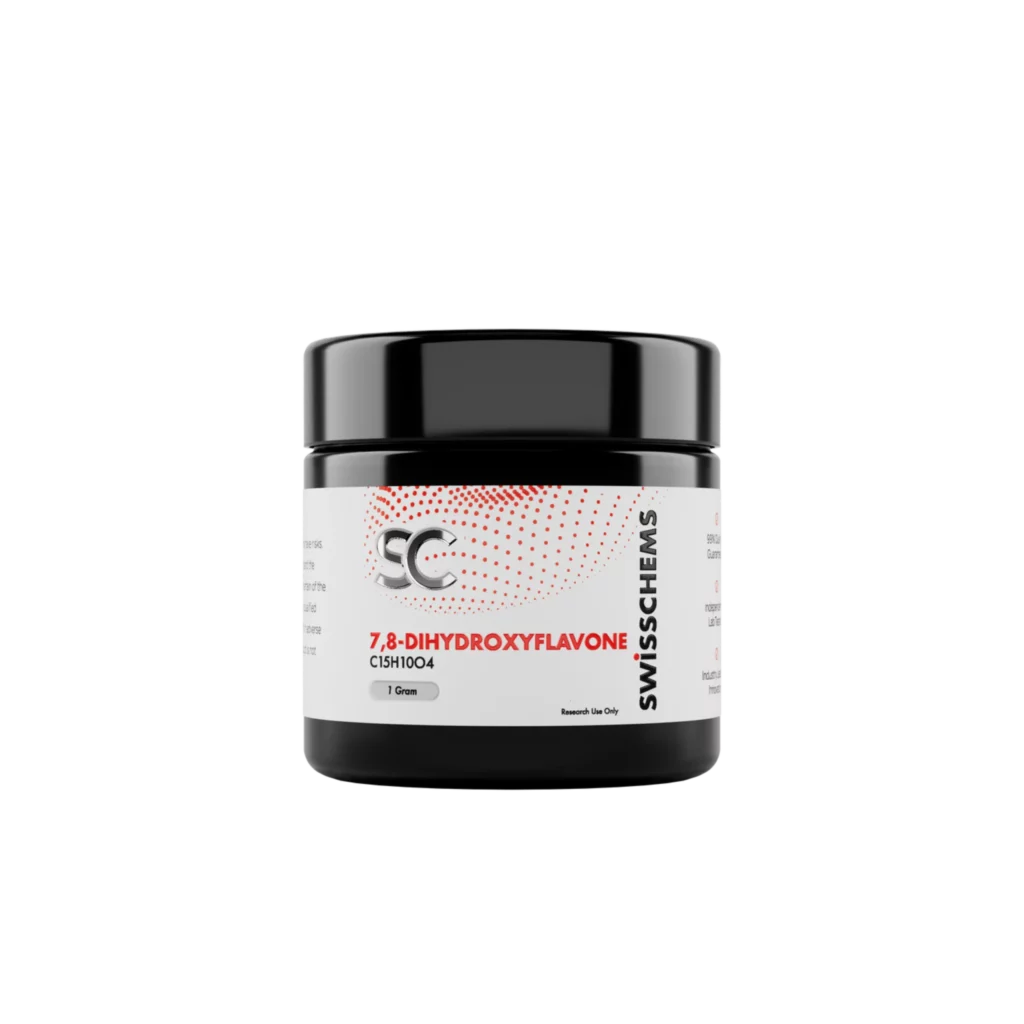
7,8-Dihydroxyflavone – Powder, 1 gram
During our packaging transition, you may receive products with either our previous or updated label. Rest assured, the formulation, purity and quality remain exactly same as standards.

7,8-Dihydroxyflavone (7,8-DHF) is a flavonoid compound studied for specific molecular pathway interactions in experimental models, with laboratory research indicating selective TrkB receptor modulation properties. Research interest centers on its proposed role as a tool compound for investigating TrkB receptor-mediated signalling distinct from peptide-based neurotrophic factor research. This powder format supports custom solution preparation for in vitro and in vivo research protocols. Research applications include TrkB receptor pharmacology, comparative flavonoid receptor-modulator studies, and small-molecule neurotrophic signalling research.
- High Purity – 99% Purity Guaranteed
- Independently Lab Tested
- Research Grade Quality
- For Laboratory Research Use Only
3D Molecular Structure
Drag to rotate · scroll to zoom| Chemical Formula | C15H10O4 |
|---|---|
| Synonyms | ADB6MA8ZV2, CHEMBL75267, Spectrum_001087, Spectrum2_000952, Spectrum3_000213 |
| Molar Mass | 254.24 g/mol |
| CAS Number | 38183-03-08 |
| PubChem CID | 1880 |
| Total Compound Content | 1 gram |
| Shelf Life | 36 months |
Every batch is independently lab tested for identity, purity and potency. View our lab testing program →
What solvents are typically used to prepare 7,8-Dihydroxyflavone powder for cell-based research applications?
DMSO is the standard solvent for preparing concentrated stock solutions of 7,8-Dihydroxyflavone given its limited aqueous solubility, with researchers typically diluting stock solutions into cell culture media or assay buffer immediately before use. Final DMSO concentration in experimental wells is generally kept low (well under 1%) to avoid solvent-related confounds on the cellular model under study.
How does 7,8-Dihydroxyflavone's small-molecule structure compare to peptide-based TrkB pathway research tools?
As a small-molecule flavonoid, 7,8-Dihydroxyflavone offers researchers a chemically stable alternative to peptide-based neurotrophic factor research tools, which often face stability and blood-brain barrier penetration limitations in experimental design. Comparative research examining both compound classes at the TrkB receptor allows investigators to characterise whether observed signalling outcomes depend on receptor engagement mechanism or are specific to one structural class of research tool.
What receptor-binding assays are used to characterise 7,8-Dihydroxyflavone's TrkB selectivity profile?
Radioligand displacement assays and surface plasmon resonance are standard methods for quantifying 7,8-Dihydroxyflavone's binding affinity at the TrkB receptor, typically run alongside parallel assays at related receptor tyrosine kinases (such as TrkA or TrkC) to establish selectivity. These binding data are usually paired with cell-based functional assays measuring downstream receptor autophosphorylation to confirm that binding translates to receptor activation in the specific experimental model under study.