Product Usage: This product is intended for research purposes only.
All product information available on this website is for educational purposes only. Any form of bodily introduction into humans or animals is strictly prohibited by law. This product should only be handled by licensed and qualified professionals. It is not a drug, food, or cosmetic, and must not be misbranded, misused, or mislabeled as such.
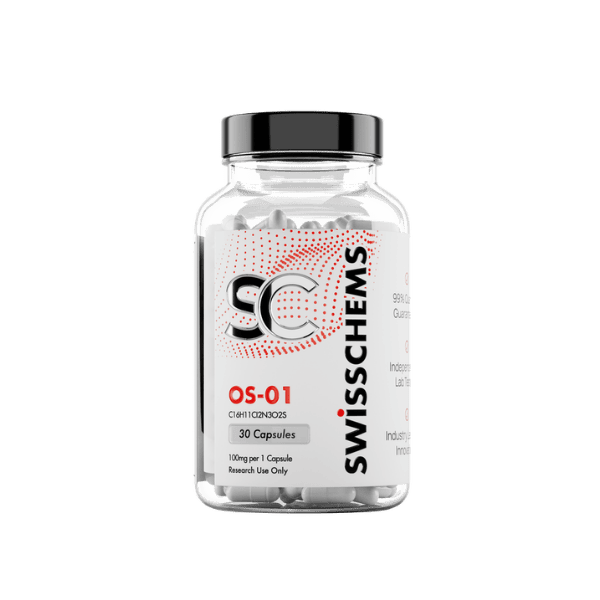
OS-01 100mg / 30caps
During our packaging transition, you may receive products with either our previous or updated label. Rest assured, the formulation, purity and quality remain exactly the same as per our standards.

OS-01 is a synthetic peptide-based compound studied in experimental models for its role in modulating cellular signalling pathways associated with senescence, mitochondrial function, and structural protein regulation. Research investigates its influence on transcriptional responses related to tissue maintenance and stress-adaptive cellular mechanisms.
- High Purity – 99% Purity Guaranteed
- Independently Lab Tested
- Research Grade Quality
- For Laboratory Research Use Only
| Chemical Formula | C15H9Cl2N3O2S |
|---|---|
| Synonyms | O-304 | ATX-304 | 4-chloro-N-[2-[(4-chlorophenyl)methyl]-3-oxo-1,2,4-thiadiazol-5-yl]benzamide | Benzamide |
| Molar Mass | 380.25 g/mo |
| CAS Number | 1261289-04-6 |
| PubChem CID | 50923806 |
| Total Compound Content | 3,000 mg (100 mg per capsule) |
| Shelf Life | 36 months |
Every batch is independently lab tested for identity, purity and potency. View our lab testing program →
What is p16INK4a and why is it important in senescence research?
p16INK4a, encoded by the CDKN2A locus, is a cyclin-dependent kinase inhibitor that suppresses CDK4/CDK6 activity, preventing retinoblastoma protein (Rb) phosphorylation and promoting cell-cycle arrest. It is one of the most widely utilized molecular markers of cellular senescence and is frequently employed as a readout in studies examining senescence-associated pathways, senescence burden, and cellular state transitions. Changes in p16INK4a expression are commonly used to evaluate the activity of compounds investigated for senolytic or senomorphic properties.
What is the SASP and why is its modulation a research target?
The senescence-associated secretory phenotype (SASP) is a collection of signaling molecules produced by senescent cells, including cytokines, chemokines, growth factors, proteases, and extracellular matrix-modifying enzymes. SASP-associated signaling can influence neighboring cells, alter local signaling environments, and modulate numerous downstream molecular pathways. Because SASP activity is considered a central feature of senescent cellular states, modulation of SASP-associated pathways has become a major area of investigation in cellular senescence research. Compounds that alter SASP output without eliminating senescent cells are commonly classified as senomorphic agents, whereas compounds that selectively remove senescent cells are classified as senolytics.
How does OS-01 differ from other compounds investigated in senescence research?
OS-01 is a short synthetic peptide investigated primarily for its effects on senescence-associated molecular pathways, p16INK4a-related regulatory mechanisms, and SASP-associated signaling networks. Unlike many established small-molecule senescence research compounds that target kinase signaling, apoptosis-regulatory pathways, or survival networks, OS-01 represents a peptide-based approach to senescence modulation. Its mechanism remains under active investigation, making it a useful research tool for studies exploring peptide-mediated regulation of senescence-associated processes, molecular aging pathways, and comparative senomodulatory pharmacology.
-
SALE

-
-
SALE
-
-
-
SALE