Product Usage: This product is intended for research purposes only.
All product information available on this website is for educational purposes only. Any form of bodily introduction into humans or animals is strictly prohibited by law. This product should only be handled by licensed and qualified professionals. It is not a drug, food, or cosmetic, and must not be misbranded, misused, or mislabeled as such.

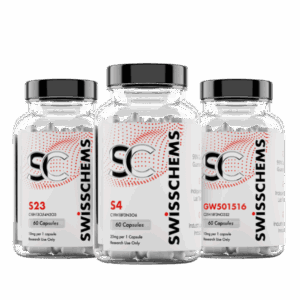
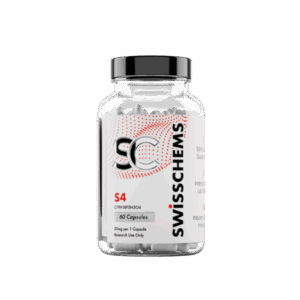
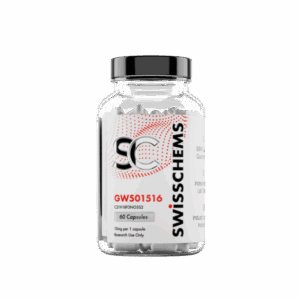
S4 Andarine + GW-501516 Cardarine Stack
1121 in stock
11413 in stock
1121 in stock
During our packaging transition, you may receive products with either our previous or updated label. Rest assured, the formulation, purity and quality remain exactly the same as per our standards.

This research stack pairs S4 (Andarine), a synthetic research molecule studied for selective molecular pathway interactions and specific binding properties, with GW-501516 (Cardarine), a research compound studied for metabolic pathway modulation. Combined research models allow investigation into how selective receptor engagement and metabolic signalling may intersect within a single experimental framework. Research applications include comparative receptor-metabolic pathway studies and dual-compound experimental protocol design.
- High Purity – 99% Purity Guaranteed
- Independently Lab Tested
- Research Grade Quality
- For Laboratory Research Use Only
| Synonyms | S4 Andarine + GW-501516 Cardarine Stack |
|---|---|
| Shelf Life | 36 months |
Every batch is independently lab tested for identity, purity and potency. View our lab testing program →
What distinct research pathways does each compound in this stack address?
S4 (Andarine) is studied for selective molecular pathway binding properties, while GW-501516 is studied for metabolic pathway modulation relevant to glucose transport and lipid metabolism research. Combined research protocols allow investigators to examine how these two distinct mechanisms may interact within shared experimental models.
What experimental models are used to study this two-compound combination's effects on receptor and metabolic pathways?
Cell-based receptor binding assays for the S4 component, alongside metabolic flux measurements (such as glucose uptake and lipid oxidation assays) for the GW-501516 component, are standard methods for studying this combination, typically compared across single-compound and combined-compound treatment arms relative to vehicle controls.
How should researchers structure comparative protocols using this two-compound stack?
Paired experimental designs incorporating single-compound and combined-compound treatment arms, alongside vehicle controls, allow researchers to isolate the contribution of each compound and identify any combination-specific effects on selected receptor and metabolic research endpoints.