Product Usage: This product is intended for research purposes only.
All product information available on this website is for educational purposes only. Any form of bodily introduction into humans or animals is strictly prohibited by law. This product should only be handled by licensed and qualified professionals. It is not a drug, food, or cosmetic, and must not be misbranded, misused, or mislabeled as such.
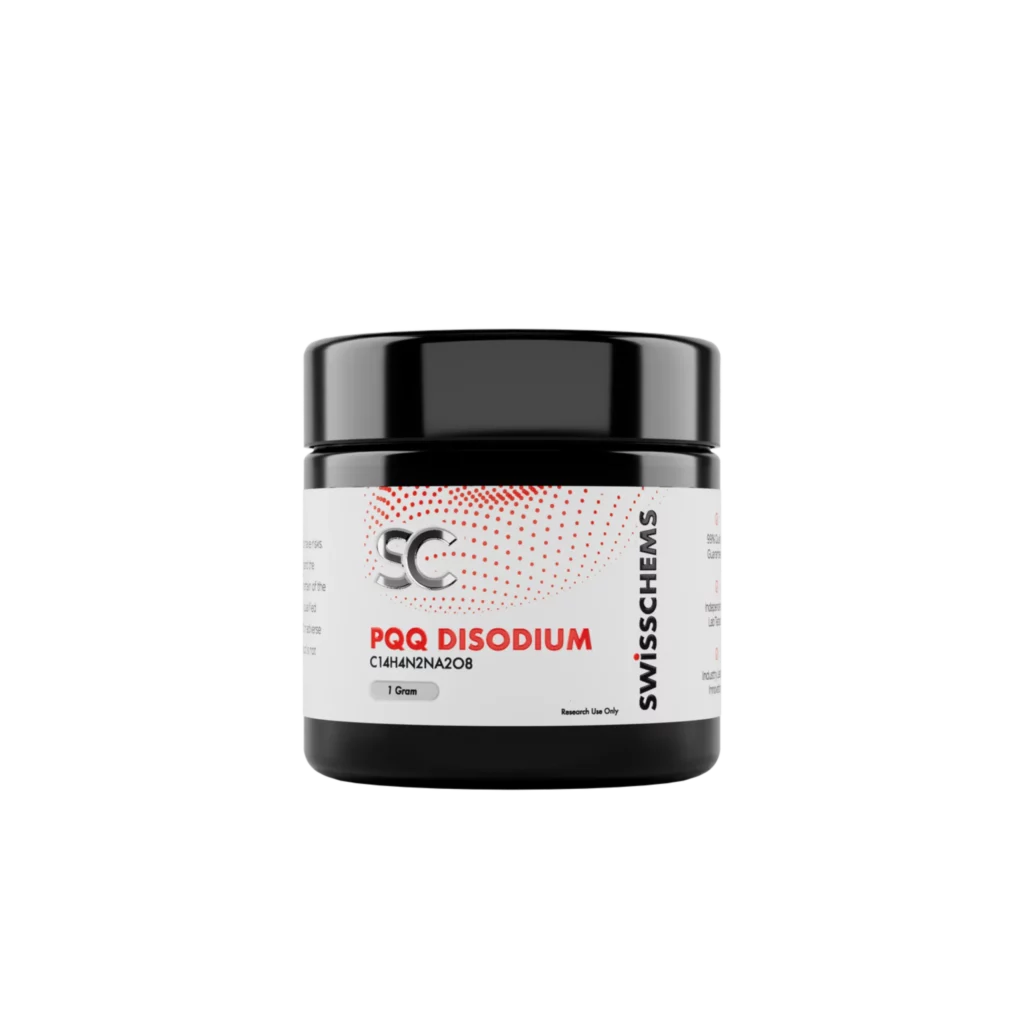
PQQ Disodium – Powder, 1 gram
During our packaging transition, you may receive products with either our previous or updated label. Rest assured, the formulation, purity and quality remain exactly same as standards.

PQQ disodium is the disodium salt form of pyrroloquinoline quinone, a small redox-active aromatic compound studied for its role as a bacterial enzyme cofactor and, in mammalian cell models, for proposed effects on mitochondrial biogenesis signalling. Research interest centers on its reported activation of PGC-1alpha-dependent transcriptional pathways governing mitochondrial DNA replication and biogenesis. Research applications include mitochondrial biogenesis pathway studies, redox cofactor chemistry research, and PGC-1alpha signalling investigation.
- High Purity – 99% Purity Guaranteed
- Independently Lab Tested
- Research Grade Quality
- For Laboratory Research Use Only
| Chemical Formula | C14H4N2O8Na2 |
|---|---|
| Synonyms | Pyrroloquinoline quinone (disodium salt), CS-5599, HY-100196A |
| Molar Mass | 330.21 g/mol |
| CAS Number | 72909-34-3 |
| PubChem CID | 1024 |
| Total Compound Content | 1 gram |
| Shelf Life | 36 months |
Every batch is independently lab tested for identity, purity and potency. View our lab testing program →
What is PQQ's established biochemical role as a bacterial enzyme cofactor?
PQQ functions as the redox-active prosthetic group for a class of bacterial quinoprotein dehydrogenases (such as methanol dehydrogenase and glucose dehydrogenase), where it cycles between oxidized and reduced quinone states to accept and transfer electrons during substrate oxidation. This well-characterised cofactor chemistry provides the structural and redox basis for PQQ's broader research interest, including its separately investigated activity in mammalian cell signalling contexts.
What cell-based readouts are used to study PQQ's reported effects on mitochondrial biogenesis?
Standard approaches include quantifying mitochondrial DNA copy number relative to nuclear DNA (by qPCR), measuring mitochondrial mass markers such as citrate synthase enzymatic activity or fluorescent mitochondrial dyes, and assessing expression of PGC-1alpha and its downstream target genes (such as NRF1, TFAM, and components of the electron transport chain) by qPCR or Western blot following PQQ exposure in cell culture models. These readouts are typically assessed over a multi-day exposure period consistent with the timescale of biogenesis-related transcriptional and structural changes.
Why is the disodium salt form used rather than the free acid form of PQQ in cell-culture research?
The disodium salt form provides substantially improved aqueous solubility compared to the free acid form of PQQ, which is important for achieving stable, reproducible concentrations in aqueous cell-culture media without requiring organic co-solvents that could independently affect cell physiology. This solubility advantage makes the disodium salt the more practical choice for most in vitro cell-based experimental protocols.
-
-
SALE
-