Product Usage: This product is intended for research purposes only.
All product information available on this website is for educational purposes only. Any form of bodily introduction into humans or animals is strictly prohibited by law. This product should only be handled by licensed and qualified professionals. It is not a drug, food, or cosmetic, and must not be misbranded, misused, or mislabeled as such.

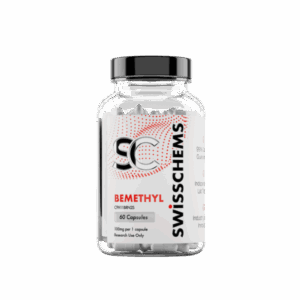
Bromantane (25mg/capsule), 60 Capsules
During our packaging transition, you may receive products with either our previous or updated label. Rest assured, the formulation, purity and quality remain exactly the same as per our standards.

Bromantane (Ladasten) is an adamantane-derived compound that has been extensively investigated for its interactions with monoaminergic signaling systems and neurotransmitter-associated regulatory pathways. Its pharmacological profile involves modulation of dopamine transporter (DAT) and serotonin transporter (SERT) systems together with regulation of enzymes involved in monoamine biosynthesis, including tyrosine hydroxylase and aromatic L-amino acid decarboxylase. Experimental investigations have also examined its influence on transcriptional regulatory mechanisms, protein expression networks, and signal transduction pathways associated with monoaminergic system function. Research applications include transporter pharmacology, monoamine signaling pathway characterization, enzyme regulation studies, and mechanistic investigation of neurotransmitter-associated regulatory systems.
- High Purity – 99% Purity Guaranteed
- Independently Lab Tested
- Research Grade Quality
- For Laboratory Research Use Only
3D Molecular Structure
Drag to rotate · scroll to zoom| Chemical Formula | C16H20BrN |
|---|---|
| Synonyms | 2-bromophenyl-1-amino adamantane, bromontan, Ladasten |
| Molar Mass | 306.24 g/mol |
| CAS Number | 87913-26-6 |
| PubChem CID | 4660557 |
| Total Compound Content | 1,500 mg (25 mg per capsule) |
| Shelf Life | 36 months |
How does Bromantane differ from classical monoamine transporter ligands?
Bromantane exhibits a distinct pharmacological profile characterized by interactions with monoamine transporter systems together with modulation of enzymes involved in monoamine-associated signaling pathways, including tyrosine hydroxylase (TH) and aromatic L-amino acid decarboxylase (AAAD). These properties make Bromantane a useful research tool for investigating transporter pharmacology, enzyme regulation, transcriptional control mechanisms, and the relationship between transporter activity and biosynthetic pathway modulation
What is the significance of Bromantane's adamantane scaffold in pharmacological research?
The adamantane scaffold provides a rigid three-dimensional molecular framework that influences physicochemical properties, target interactions, and structure-activity relationships. Bromantane's halogenated adamantane structure has made it a valuable compound for investigating how scaffold architecture affects transporter interactions, signaling pathway activity, and ligand-receptor pharmacology. Research applications frequently include comparative analyses of adamantane-derived compounds and their distinct molecular interaction profiles.
Why is Bromantane useful for studying monoamine-associated regulatory pathways?
Experimental investigations have reported interactions with dopamine transporter (DAT) and serotonin transporter (SERT) systems together with modulation of regulatory enzymes associated with monoaminergic signaling networks. These characteristics have established Bromantane as a useful research tool for examining transporter-enzyme relationships, signal transduction mechanisms, transcriptional regulatory processes, and molecular pathways associated with monoamine system function.