Product Usage: This product is intended for research purposes only.
All product information available on this website is for educational purposes only. Any form of bodily introduction into humans or animals is strictly prohibited by law. This product should only be handled by licensed and qualified professionals. It is not a drug, food, or cosmetic, and must not be misbranded, misused, or mislabeled as such.
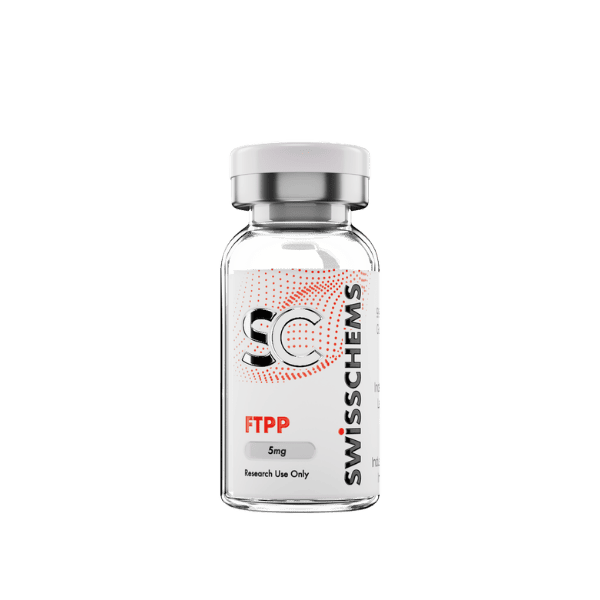
FTPP (Adipotide) 5mg
During our packaging transition, you may receive products with either our previous or updated label. Rest assured, the formulation, purity and quality remain exactly the same as per our standards.

FTPP (Adipotide) is a synthetic peptide conjugate combining a prohibitin-targeting homing sequence with a proapoptotic domain, designed to selectively engage prohibitin proteins expressed on the surface of vascular endothelial cells supplying specific tissue beds. Research interest centers on its targeted proapoptotic mechanism, distinguishing it from systemically acting apoptosis-inducing compounds. Research applications include prohibitin receptor-targeting research, vascular-targeted peptide delivery studies, and adipose tissue vasculature pathway investigation.
- High Purity – 99% Purity Guaranteed
- Independently Lab Tested
- Research Grade Quality
- For Laboratory Research Use Only
3D Molecular Structure
Drag to rotate · scroll to zoom| Chemical Formula | C111H206N36O28S2 |
|---|---|
| Synonyms | EX-A6186, proapototic peptide |
| Molar Mass | 2557.2 g/mol |
| CAS Number | 859216-15-2 |
| PubChem CID | 163360068 |
| Total Compound Content | 5mg (1 vial) |
| Shelf Life | 36 months |
Every batch is independently lab tested for identity, purity and potency. View our lab testing program →
Q: What is the mechanistic basis of FTPP's prohibitin-targeted homing strategy?
FTPP incorporates a CKGGRAKDC peptide sequence that binds selectively to prohibitin, a protein expressed on the luminal surface of vascular endothelial cells supplying white adipose tissue at higher density than in many other vascular beds. This homing domain directs the conjugated proapoptotic payload specifically to prohibitin-expressing endothelium, providing a model system for studying tissue-selective vascular targeting strategies based on differential surface receptor expression rather than systemic drug distribution.
How does the proapoptotic (KLAKLAK)2 domain in FTPP induce localized cell death once internalized?
The (KLAKLAK)2 domain is a synthetic cationic amphipathic peptide that, upon cellular internalisation following prohibitin-mediated binding, disrupts mitochondrial membrane integrity, triggering the intrinsic apoptotic pathway in the targeted endothelial cell. Because this proapoptotic domain only reaches functionally relevant intracellular concentrations following prohibitin-dependent uptake, the overall mechanism is studied as a model for spatially restricted apoptosis induction, with cell death confined largely to cells expressing the target receptor at sufficient density.
What experimental approaches validate prohibitin-targeting specificity in FTPP research?
Competitive binding assays using free prohibitin-binding peptide (without the proapoptotic payload) to block FTPP uptake, alongside biodistribution studies tracking labeled FTPP localisation across different vascular beds, are standard methods for confirming the homing domain's binding specificity. Comparative studies using a scrambled or non-binding control peptide sequence conjugated to the same proapoptotic domain are also used to confirm that observed effects depend on the specific prohibitin-targeting sequence rather than nonspecific peptide uptake or toxicity.
-
-

-
SALE
-
SALE
-
-

-
SALE
-
SALE