Product Usage: This product is intended for research purposes only.
All product information available on this website is for educational purposes only. Any form of bodily introduction into humans or animals is strictly prohibited by law. This product should only be handled by licensed and qualified professionals. It is not a drug, food, or cosmetic, and must not be misbranded, misused, or mislabeled as such.
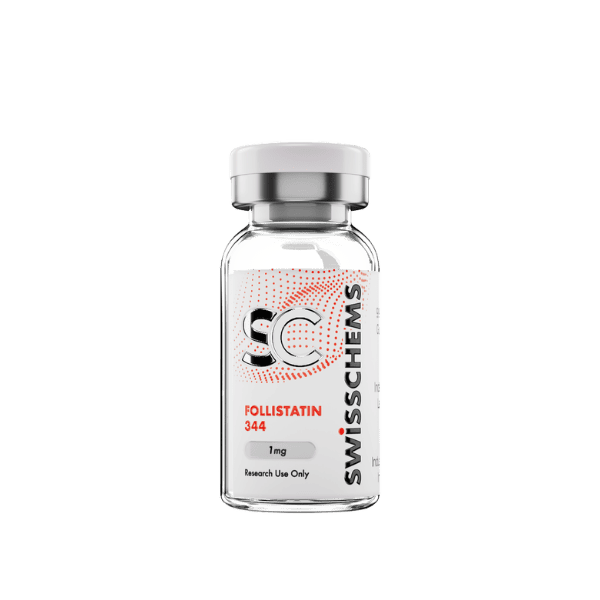
Follistatin-344 1mg
NOTE: In some cases wherein the assigned top colors are out of stock, a different top color will be used to ensure that your order will not be delayed.
Minimum Order: 1 Vial
Peptides are stable at room temperature and can be stored in their original packaging for several days to weeks. For longer storage, keep them at 4 °C or colder, away from intense light. Do not shake peptides before or after reconstitution, refrigerate them, and handle with care.
During our packaging transition, you may receive products with either our previous or updated label. Rest assured, the formulation, purity and quality remain exactly the same as per our standards.

Follistatin-344 (FS-344) is the predominant isoform of follistatin, an endogenous glycoprotein that functions as a high-affinity binding protein for multiple members of the TGF-β superfamily. By sequestering ligands including activins, myostatin (GDF-8), and selected bone morphogenetic proteins (BMPs), Follistatin-344 prevents receptor engagement and downstream Smad-dependent signal transduction. Experimental studies have utilized FS-344 to investigate activin receptor signaling, myostatin-associated regulatory pathways, TGF-β superfamily biology, ligand-receptor interaction dynamics, and Smad2/3- and Smad1/5/8-mediated transcriptional regulation. Its broad ligand-binding profile and well-characterized mechanism make Follistatin-344 a valuable research tool for studies of growth factor signaling networks, extracellular ligand sequestration, pathway cross-talk within the TGF-β superfamily, and comparative investigations of myostatin and activin antagonism.
- High Purity – 99% Purity Guaranteed
- Independently Lab Tested
- Research Grade Quality
- For Laboratory Research Use Only
| Chemical Formula | C203H317N55O64S1 |
|---|---|
| Synonyms | Follistatin FST-344, FS-344, Activin-binding protein |
| Molar Mass | ~35,000 g/mol |
| CAS Number | 100043-71-8 |
| PubChem CID | N/A |
| Total Compound Content | 1 mg per vial |
| Shelf Life | 36 months |
Every batch is independently lab tested for identity, purity and potency. View our lab testing program →
What is the difference between Follistatin-344 and Follistatin-315, and why does isoform matter for research?
Follistatin-344 (FS-344) and Follistatin-315 (FS-315) are alternative splice variants of the FST gene that differ in their C-terminal sequence composition. FS-344 contains an additional peptide region associated with interactions involving heparan sulfate-containing structures, influencing its localization and distribution characteristics. FS-315 lacks this extension and displays different extracellular distribution properties. These structural differences make isoform selection an important consideration in studies investigating ligand sequestration dynamics, TGF-β superfamily signaling, extracellular protein interactions, and growth factor distribution mechanisms.
Which TGF-β superfamily members does follistatin antagonize, and how selective is this interaction?
Follistatin functions as a broad-spectrum extracellular binding protein for multiple TGF-β superfamily ligands. Its highest-affinity interactions occur with activin family members, while additional binding activity has been documented for myostatin (GDF-8) and selected bone morphogenetic proteins (BMPs). Because follistatin interacts with several ligand families rather than a single target, it is widely used in studies examining activin signaling, myostatin biology, BMP-associated pathways, receptor-ligand competition, and cross-talk within TGF-β superfamily signaling networks.
What experimental evidence supports follistatin's role in TGF-β superfamily signaling regulation?
Extensive experimental research has demonstrated that follistatin modulates TGF-β superfamily signaling through direct ligand sequestration, preventing receptor engagement and downstream Smad-dependent signal transduction. Studies utilizing recombinant protein administration, transgenic expression systems, gene-transfer approaches, and in vitro signaling models have consistently shown suppression of activin-, myostatin-, and BMP-associated signaling pathways. These findings have established follistatin as a widely used research tool for investigating extracellular growth factor regulation, ligand-neutralization mechanisms, Smad signaling networks, and TGF-β superfamily pathway biology.