Product Usage: This product is intended for research purposes only.
All product information available on this website is for educational purposes only. Any form of bodily introduction into humans or animals is strictly prohibited by law. This product should only be handled by licensed and qualified professionals. It is not a drug, food, or cosmetic, and must not be misbranded, misused, or mislabeled as such.
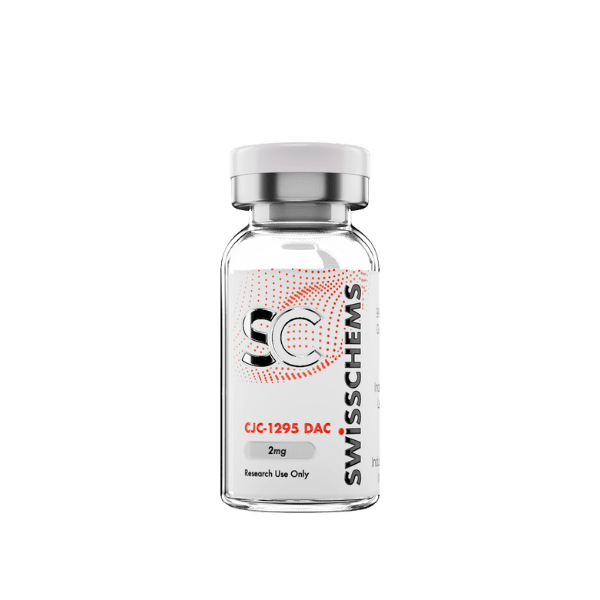
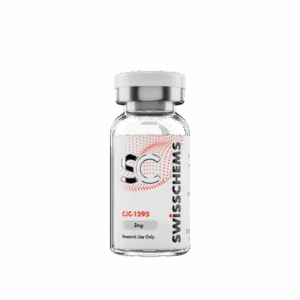
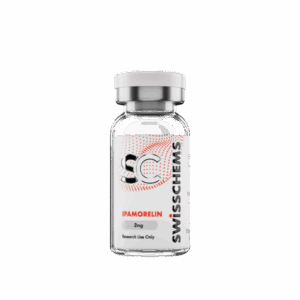
CJC-1295 with DAC, 2mg
During our packaging transition, you may receive products with either our previous or updated label. Rest assured, the formulation, purity and quality remain exactly the same as per our standards.

CJC-1295 with DAC is a synthetic modified peptide compound studied for its interactions with growth hormone-releasing hormone (GHRH) receptor pathways in experimental models. The Drug Affinity Complex (DAC) modification — a maleimidopropionyl-lysine moiety at the C-terminus — is studied for its capacity to reversibly bind albumin in experimental systems, producing extended stability compared to the unmodified CJC-1295 variant. The compound is designed with a 30-amino acid sequence structure incorporating four amino acid substitutions that confer enhanced protease resistance relative to native GHRH(1-29). Research applications include GHRH receptor pathway studies, growth hormone secretagogue signalling research, and comparative DAC-modified versus unmodified peptide pharmacology.
- High Purity – 99% Purity Guaranteed
- Independently Lab Tested
- Research Grade Quality
- For Laboratory Research Use Only
3D Molecular Structure
Drag to rotate · scroll to zoom| Chemical Formula | C165H269N47O46 |
|---|---|
| Synonyms | CJC1295 With DAC, 446262-90-4 |
| Molar Mass | 3647.2 g/mol |
| CAS Number | 446262-90-4 |
| PubChem CID | 91971820 |
| Total Compound Content | 2mg per vial |
| Shelf Life | 36 months |
Every batch is independently lab tested for identity, purity and potency. View our lab testing program →
What is the Drug Affinity Complex (DAC) modification and how does it affect CJC-1295's stability in research models?
The DAC modification in CJC-1295 is a maleimidopropionyl-lysine moiety incorporated at the C-terminus of the peptide sequence, studied for its capacity to reversibly bind cysteine-34 of albumin in experimental systems. This albumin-binding interaction is studied for its role in significantly extending the peptide's stability in biological research models relative to the non-DAC CJC-1295 variant, making the DAC form a standard research tool in protocols requiring sustained receptor pathway engagement over extended experimental timelines.
How do the four amino acid substitutions in CJC-1295 differ from native GHRH(1-29)?
CJC-1295 incorporates D-Ala at position 2, Gln at position 8, Ala at position 15, and Leu at position 27 relative to native GHRH(1-29), substitutions studied for their capacity to confer enhanced resistance to proteolytic degradation while preserving GHRH receptor binding affinity. These modifications are examined in comparative structure-activity research contrasting CJC-1295's stability and receptor binding profile against native GHRH(1-29) and other GHRH analogues.
What advantages does the 10-vial KIT format provide for extended research programs?
The 10-vial KIT format is particularly useful for longitudinal investigations, repeated-dose studies, multi-arm experimental designs, pharmacokinetic research, and chronic pathway-signaling programs requiring consistent compound availability across multiple study phases. Individually sealed vials allow compound to remain lyophilized until needed, supporting stability throughout extended research timelines. The use of matched-batch material across all ten vials also helps minimize variability between experimental sessions, making the KIT format well suited to long-duration receptor-signaling and comparative pharmacology studies.
-
-
-
-
-
-
SALE
-