Product Usage: This product is intended for research purposes only.
All product information available on this website is for educational purposes only. Any form of bodily introduction into humans or animals is strictly prohibited by law. This product should only be handled by licensed and qualified professionals. It is not a drug, food, or cosmetic, and must not be misbranded, misused, or mislabeled as such.
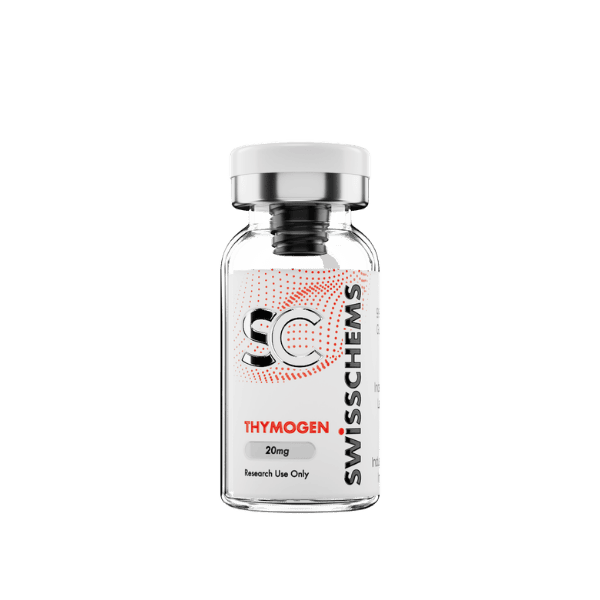
Thymogen, 20mg
NOTE: In some cases wherein the assigned top colors are out of stock, a different top color will be used to ensure that your order will not be delayed.
Peptides are stable at room temperature and can be stored in their original packaging for several days to weeks. For longer storage, keep them at 4 °C or colder, away from intense light. Do not shake peptides before or after reconstitution, refrigerate them, and handle with care.
You can purchase BAC water here:
BAC 10ml
During our packaging transition, you may receive products with either our previous or updated label. Rest assured, the formulation, purity and quality remain exactly the same as per our standards.

Thymogen is a synthetic bioregulatory peptide studied for its activity in immune system modulation research models. Research has examined its proposed capacity to enhance T-cell production and differentiation, stimulate interferon secretion, elevate cyclic nucleotide levels, and support innate immune pathway signalling in experimental settings. Research applications include immune modulation pathway studies, T-cell differentiation research, and comparative bioregulatory dipeptide pharmacology.
- High Purity – 99% Purity Guaranteed
- Independently Lab Tested
- Research Grade Quality
- For Laboratory Research Use Only
3D Molecular Structure
Drag to rotate · scroll to zoom| Chemical Formula | C16H19N3O5 |
|---|---|
| Synonyms | Oglufanide, Thymogen |
| Molar Mass | 333.34 g/mol |
| CAS Number | 38101-59-6 |
| PubChem CID | 100094 |
| Total Compound Content | 20mg per vial |
| Shelf Life | 36 months |
Every batch is independently lab tested for identity, purity and potency. View our lab testing program →
What T-cell differentiation assays are used to study Thymogen's proposed immune modulation activity?
Flow cytometry-based immunophenotyping of T-lymphocyte populations (measuring CD3, CD4, CD8 and differentiation markers) is a standard method for studying Thymogen's proposed effects on T-cell production and differentiation in cell-based and ex vivo immune cell models, typically comparing treated versus untreated lymphocyte preparations across a defined exposure period. These assays allow researchers to quantify shifts in T-cell subpopulation distribution associated with compound exposure.
How is Thymogen's proposed effect on cyclic nucleotide levels measured in immune cell research?
Enzyme immunoassay or mass spectrometry-based quantification of cyclic AMP and cyclic GMP levels in immune cell preparations (such as isolated lymphocytes or macrophage cell lines) is used to study Thymogen's proposed effects on cyclic nucleotide signalling, typically measured at defined timepoints following compound exposure. These molecular readouts are often paired with downstream functional immune assays (such as interferon secretion measurement via ELISA) to connect cyclic nucleotide changes to broader immune pathway outcomes.
What experimental stress models are used to study Thymogen's proposed role in immune resilience research?
Immune cell models subjected to defined stress challenges (such as oxidative stress, nutrient deprivation, or pathogen-associated molecular pattern exposure) are used to study Thymogen's proposed contribution to immune resilience, typically measuring cell viability, cytokine production profiles, and functional immune readouts under stress conditions with and without compound exposure. These stress-challenge models allow researchers to characterise whether Thymogen's immune-modulating effects are most relevant under experimentally induced immune stress.