Product Usage: This product is intended for research purposes only.
All product information available on this website is for educational purposes only. Any form of bodily introduction into humans or animals is strictly prohibited by law. This product should only be handled by licensed and qualified professionals. It is not a drug, food, or cosmetic, and must not be misbranded, misused, or mislabeled as such.
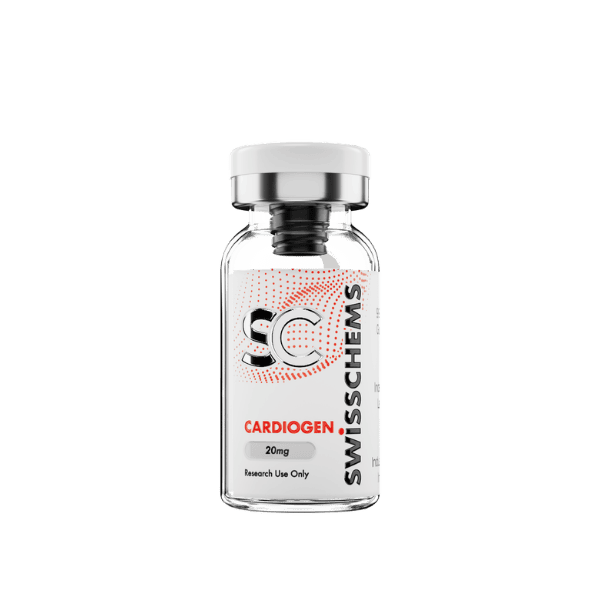
Cardiogen, 20mg
During our packaging transition, you may receive products with either our previous or updated label. Rest assured, the formulation, purity and quality remain exactly the same as per our standards.

Cardiogen is a synthetic bioregulatory peptide under investigation for its activity in cardiac and prostate tissue models. Research interest centers on its proposed influence on molecular pathways associated with cardiovascular function and cellular regulation, including preliminary models of cardiovascular stress such as myocardial injury and hypertension. Research applications include cardiac tissue bioregulator studies, fibroblast pathway research, and comparative bioregulatory peptide pharmacology.
- High Purity – 99% Purity Guaranteed
- Independently Lab Tested
- Research Grade Quality
- For Laboratory Research Use Only
3D Molecular Structure
Drag to rotate · scroll to zoom| Chemical Formula | C18H31N7O9 |
|---|---|
| Synonyms | SCHEMBL3194515 |
| Molar Mass | 489.5 g/mol |
| PubChem CID | 11583989 |
| Total Compound Content | 20mg per vial |
| Shelf Life | 36 months |
Every batch is independently lab tested for identity, purity and potency. View our lab testing program →
What research models are used to study Cardiogen's proposed effects on cardiac fibroblast regulation?
In vitro cardiac fibroblast cultures are used to examine Cardiogen's effects on fibroblast proliferation, migration, and extracellular matrix-related gene expression, readouts relevant to cardiac tissue remodelling research following injury. Ex vivo cardiac tissue explant models and rodent myocardial injury paradigms (such as ischemia-reperfusion models) are used as complementary systems to study fibroblast-related endpoints in the context of an intact tissue environment rather than isolated cell culture alone.
How is Cardiogen studied within preclinical models of cardiovascular stress such as myocardial injury?
Rodent models of myocardial injury (including surgically induced ischemia-reperfusion) and hypertension (using pharmacological or surgical induction methods) are standard preclinical systems for studying Cardiogen's effects on cardiovascular stress-response pathways. Typical endpoints include cardiac functional measures (echocardiography-derived ejection fraction, fractional shortening), histological assessment of fibrosis or tissue damage, and molecular markers of stress-response signalling pathways in cardiac tissue samples.
What experimental approaches investigate Cardiogen's potential synergistic effects with other research compounds?
Combination studies typically pair Cardiogen with other bioregulatory peptides or cardiovascular research compounds in the same cell-based or rodent model system, comparing combined treatment effects against each compound administered individually to determine whether observed effects are additive, synergistic, or independent. This comparative experimental design is standard practice for characterising potential interaction effects between bioregulatory peptides studied for overlapping or complementary tissue-specific activity.