Product Usage: This product is intended for research purposes only.
All product information available on this website is for educational purposes only. Any form of bodily introduction into humans or animals is strictly prohibited by law. This product should only be handled by licensed and qualified professionals. It is not a drug, food, or cosmetic, and must not be misbranded, misused, or mislabeled as such.
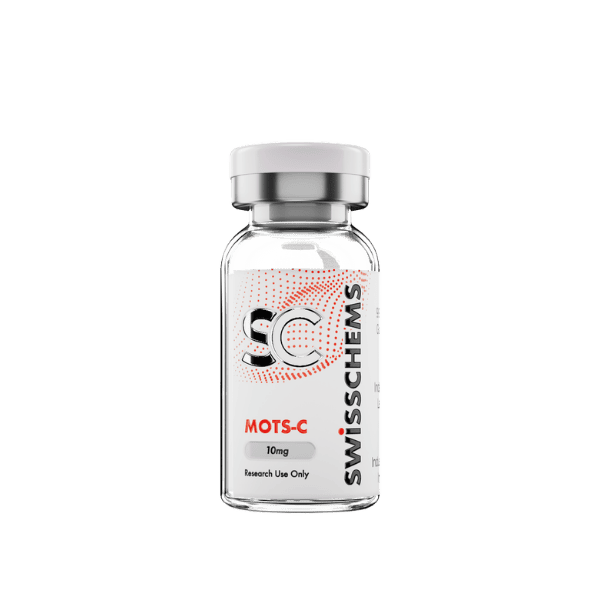
MOTS-C 10mg
During our packaging transition, you may receive products with either our previous or updated label. Rest assured, the formulation, purity and quality remain exactly the same as per our standards.

MOTS-C (Mitochondrial Open Reading Frame of the 12S rRNA-c) is a 16-amino-acid peptide encoded within the mitochondrial genome's 12S rRNA region and is classified as a mitochondria-derived peptide (MDP). Experimental investigations have examined its role in mitochondrial-to-nuclear signaling pathways, intracellular regulatory networks, and adaptive signaling mechanisms associated with mitochondrial communication systems. Research has also explored interactions with AMP-activated protein kinase (AMPK), FOXO-associated signaling pathways, transcriptional regulatory processes, and downstream signal transduction networks. Research applications include mitochondrial signaling pathway investigation, AMPK pathway characterization, FOXO signaling studies, mitochondrial communication research, and mechanistic evaluation of mitochondria-derived peptide biology.
- High Purity – 99% Purity Guaranteed
- Independently Lab Tested
- Research Grade Quality
- For Laboratory Research Use Only
3D Molecular Structure
Drag to rotate · scroll to zoom| Chemical Formula | C101H152N28O22S2 |
|---|---|
| Synonyms | Mitochondria-derived peptide, mots-c, EX-A626, Met-Arg-Trp-Gln-Glu-Met-Gly-Tyr-Ile-Phe-Tyr-Pro-Arg-Lys-Leu-Arg |
| Molar Mass | 2,174.62 g/mol |
| CAS Number | 1627580-64-6 |
| PubChem CID | 146675088 |
| Total Compound Content | 10 mg per vial |
| Shelf Life | 36 months |
What distinguishes MOTS-C from most other research peptides?
MOTS-C is a 16-amino-acid peptide encoded within the mitochondrial genome, making it part of a relatively small group of mitochondria-derived peptides (MDPs). This unique genetic origin has made MOTS-C a valuable research tool for investigating mitochondrial-to-nuclear communication pathways, intracellular signaling networks, transcriptional regulation mechanisms, and the molecular processes governing mitochondrial signaling systems.
Which signaling pathways have been associated with MOTS-C in experimental investigations?
Research involving MOTS-C has reported interactions with AMP-activated protein kinase (AMPK), FOXO-associated signaling pathways, antioxidant response element (ARE)-associated regulatory networks, and downstream transcriptional processes. These characteristics have established MOTS-C as a useful compound for studying signal transduction mechanisms, pathway-specific regulatory systems, mitochondrial communication networks, and adaptive signaling processes.
How does MOTS-C differ from other mitochondria-derived peptides such as Humanin?
Although both MOTS-C and Humanin are classified as mitochondria-derived peptides, they differ in amino acid sequence, molecular structure, signaling interactions, and pharmacological characteristics. Comparative investigations utilize these peptides to examine distinct aspects of mitochondrial signaling, peptide-mediated regulatory mechanisms, mitochondrial-to-nuclear communication pathways, and structure-function relationships within the broader class of mitochondria-derived peptides.
-

-

-
SALE

-

-
SALE