Product Usage: This product is intended for research purposes only.
All product information available on this website is for educational purposes only. Any form of bodily introduction into humans or animals is strictly prohibited by law. This product should only be handled by licensed and qualified professionals. It is not a drug, food, or cosmetic, and must not be misbranded, misused, or mislabeled as such.
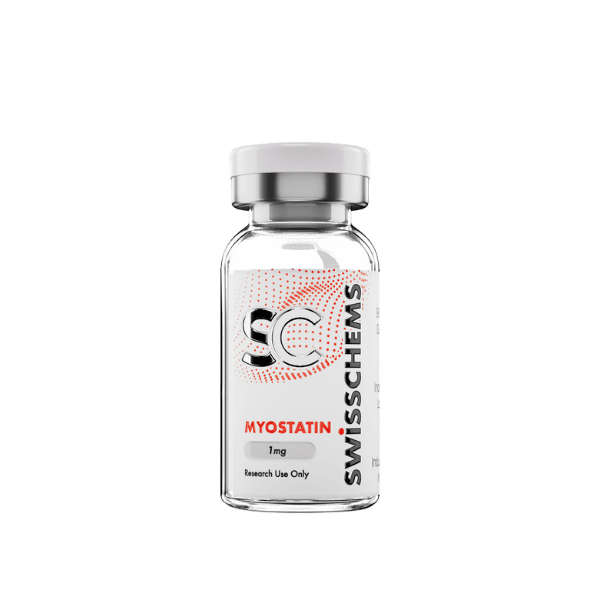
Myostatin 1mg
During our packaging transition, you may receive products with either our previous or updated label. Rest assured, the formulation, purity and quality remain exactly the same as per our standards.

MIP-7 (Myostatin Inhibitory Peptide 7) is a synthetic 24-amino-acid, C-terminally amidated peptide (AWRQNTRYSRIEAIKIQILSKLRL-NH2) derived from the N-terminal α-helical region of the mouse myostatin prodomain. In the native latent complex, this region of the prodomain helps hold mature myostatin (GDF-8) in an inactive state. MIP-7 was developed to reproduce that inhibitory interaction in a short, synthetically accessible sequence. It is not myostatin itself and does not activate the myostatin pathway. It is studied as a myostatin antagonist, binding the mature growth factor and reducing its ability to signal through activin type II receptors (ACVR2A/ACVR2B) and downstream Smad2/3. Research applications include myostatin inhibition studies, prodomain–ligand interaction research, structure–activity work on peptide-based TGF-β superfamily antagonists, and muscle biology models where myostatin signalling is suppressed.
- High Purity – 99% Purity Guaranteed
- Independently Lab Tested
- Research Grade Quality
- For Laboratory Research Use Only
3D Molecular Structure
Drag to rotate · scroll to zoom| Chemical Formula | C133H227N43O33 |
|---|---|
| Synonyms | 1621169-52-5, Myostatin inhibitory peptide 7, U8DGS69FVC Ala-Trp-Arg-Gln-Asn-Thr-Arg-Tyr-Ser-Arg-Ile-Glu-Ala-Ile-Lys-Ile-Gln-Ile-Leu-Ser-Lys-Leu-Arg-Leu-NH2, UNII-U8DGS69FVC, CHEMBL3410227, L-Alanyl-L-tryptophyl-L-arginyl-L-glutaminyl-L-asparaginyl-L-threonyl-L-arginyl-L-tyrosyl-L-seryl-L-arginyl-L-isoleucyl-L-alpha-glutamyl-L-alanyl-L-isoleucyl-L-lysyl-L-isoleucyl-L-glutaminyl-L-isoleucyl-L-leucyl-L-seryl-L-lysyl-L-leucyl-L-arginyl-L-leucinamide, orb2563812 |
| Molar Mass | 2956.5 g/mol |
| CAS Number | 1621169-52-5 |
| PubChem CID | 118732224 |
| Total Compound Content | 1 mg per vial |
| Shelf Life | 24 months |
Myostatin (GDF-8) is a TGF-β superfamily growth factor that negatively regulates skeletal muscle mass. It is synthesised as a precursor and held in a latent state by its own prodomain, which shields the receptor-binding surfaces of the mature dimer. Peptides derived from the prodomain therefore represent a direct route to myostatin inhibition.
MIP-7 comes out of structure–activity work by Takayama and colleagues (J Med Chem, 2015), which narrowed the mouse myostatin prodomain down to a minimum inhibitory sequence and then refined it. Follow-up structural studies indicate the peptide adopts an α-helical conformation and interacts with mature myostatin in a way that interferes with receptor engagement. MIP-7 is used in vitro to inhibit myostatin-induced Smad2/3 signalling and reporter activity, typically alongside recombinant myostatin as the activating ligand. Additional applications include comparison against other myostatin inhibitors (follistatin, soluble ACVR2B, antibodies), investigation of prodomain-mediated latency, and design of next-generation peptide antagonists.
Independently third-party HPLC-tested; COA available per batch.
Every batch is independently lab tested for identity, purity and potency. View our lab testing program →
Is MIP-7 the same as myostatin (GDF-8)?
No. Myostatin (GDF-8) is a ~25 kDa homodimeric growth factor that activates the ACVR2B/Smad2/3 pathway. MIP-7 is a 24-residue synthetic peptide (2956.5 g/mol) derived from the myostatin prodomain, and it is studied as an inhibitor of myostatin rather than an activator.
What is the primary research use of MIP-7?
MIP-7 is used to inhibit myostatin activity in experimental systems. A common design pairs recombinant myostatin (to activate Smad2/3 signalling) with MIP-7 to measure how effectively the peptide suppresses that response, using reporter assays, Smad2/3 phosphorylation or downstream transcriptional readouts.
What controls are important in MIP-7 experiments?
Common controls include vehicle-only samples for baseline, myostatin-only samples to confirm pathway activation, a scrambled or inactive peptide to rule out non-specific effects, and an established myostatin inhibitor (such as follistatin or a neutralising antibody) as a benchmark for inhibition.
-
-
SALE
-
SALE

-
SALE
-
-
-