Product Usage: This product is intended for research purposes only.
All product information available on this website is for educational purposes only. Any form of bodily introduction into humans or animals is strictly prohibited by law. This product should only be handled by licensed and qualified professionals. It is not a drug, food, or cosmetic, and must not be misbranded, misused, or mislabeled as such.
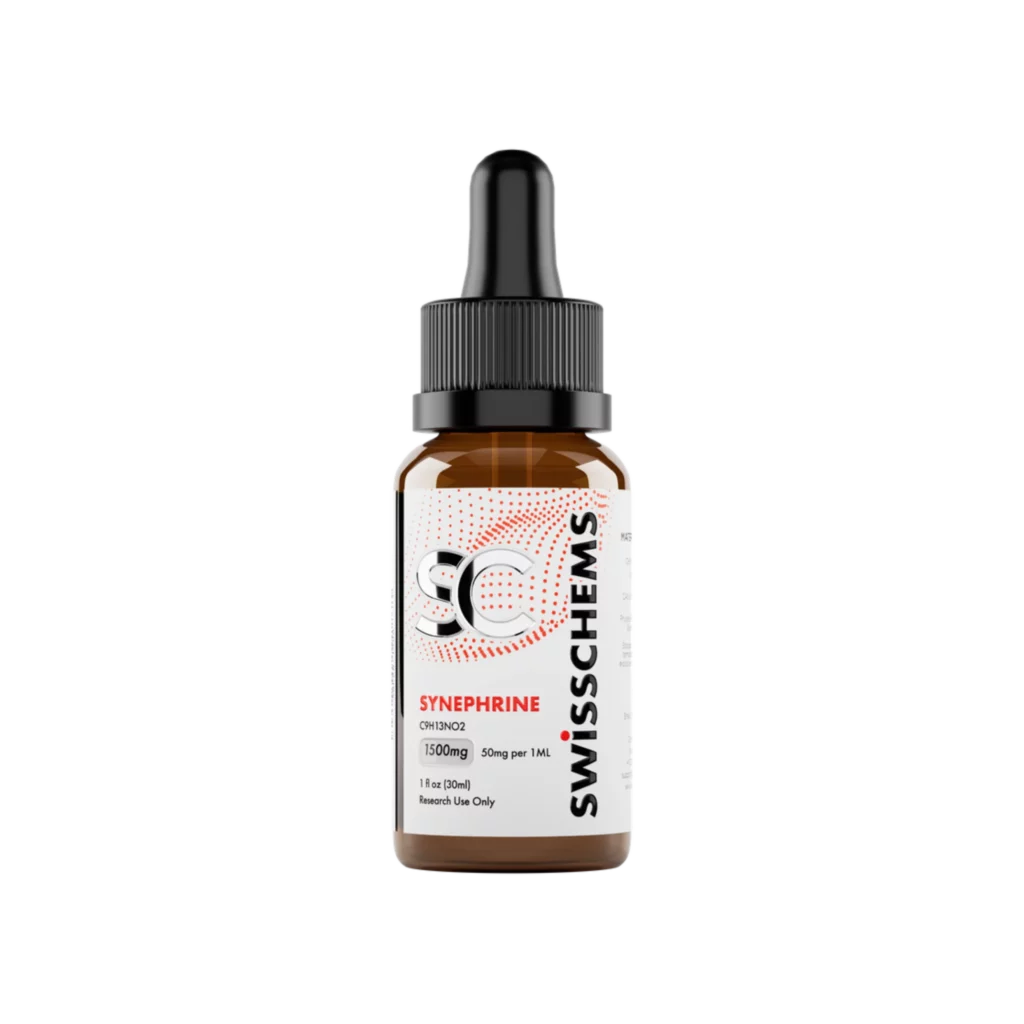
Synephrine – Solution, 1500 mg (50 mg/1 ml)
During our packaging transition, you may receive products with either our previous or updated label. Rest assured, the formulation, purity and quality remain exactly same as standards.

Synephrine is a naturally occurring protoalkaloid structurally related to phenylethanolamines, known for its interaction with adrenergic receptors. It primarily binds to β-adrenergic and α-adrenergic receptor subtypes, modulating catecholamine signaling pathways in research applications.
This compound undergoes hepatic metabolism via monoamine oxidase (MAO) and sulfation pathways, with primary clearance occurring through renal excretion. The liquid formulation (50mg/ml) enhances solubility and stability, ensuring precise measurement and controlled administration in experimental settings.
- High Purity – 99% Purity Guaranteed
- Independently Lab Tested
- Research Grade Quality
- For Laboratory Research Use Only
3D Molecular Structure
Drag to rotate · scroll to zoom| Chemical Formula | C9H13NO2 |
|---|---|
| Synonyms | Oxedrine, Parasympatol, Sympaethamine, Sympatol, Analeptin, Simpatol, Synephrin, Synthenate, Sympathol, p-Oxedrine |
| Molar Mass | 167.21 g/mol |
| CAS Number | 94-07-5 |
| PubChem CID | 7172 |
| Total Compound Content | 1500mg |
| Shelf Life | 36 months |
Every batch is independently lab tested for identity, purity and potency. View our lab testing program →
What is the basis for synephrine's reported beta-3 adrenergic receptor selectivity in research models?
Receptor subtype-selective binding and functional assays — typically comparing synephrine's potency at beta-1, beta-2, and beta-3 adrenergic receptor subtypes using cAMP accumulation or radioligand displacement methods — are used to characterise its relative selectivity profile. This research is conducted in the context of broader structure-activity work on phenylethanolamine compounds, comparing synephrine's substitution pattern to other adrenergic agonists with different subtype selectivity to map which structural features drive beta-3 preference.
How does solution format support dosing precision compared to solid powder preparations in synephrine research?
Solution format at a defined concentration (50 mg/ml) allows researchers to administer precise volumetric doses without requiring on-site weighing and dissolution, reducing a source of dosing variability in protocols requiring repeated or time-sensitive administration. This format is particularly useful in rodent pharmacokinetic studies and in vitro dose-response work where rapid, accurate dilution series preparation is required.
What structural relationship does synephrine have to other phenylethanolamine adrenergic compounds studied in receptor research?
Synephrine shares the core phenylethanolamine scaffold with related compounds in this structural class, differing in the specific pattern and position of hydroxyl and methyl substituents on the aromatic ring and amine nitrogen. These structural differences are the basis for comparative structure-activity relationship studies examining how substitution pattern influences adrenergic receptor subtype selectivity and binding affinity across the phenylethanolamine compound series.